
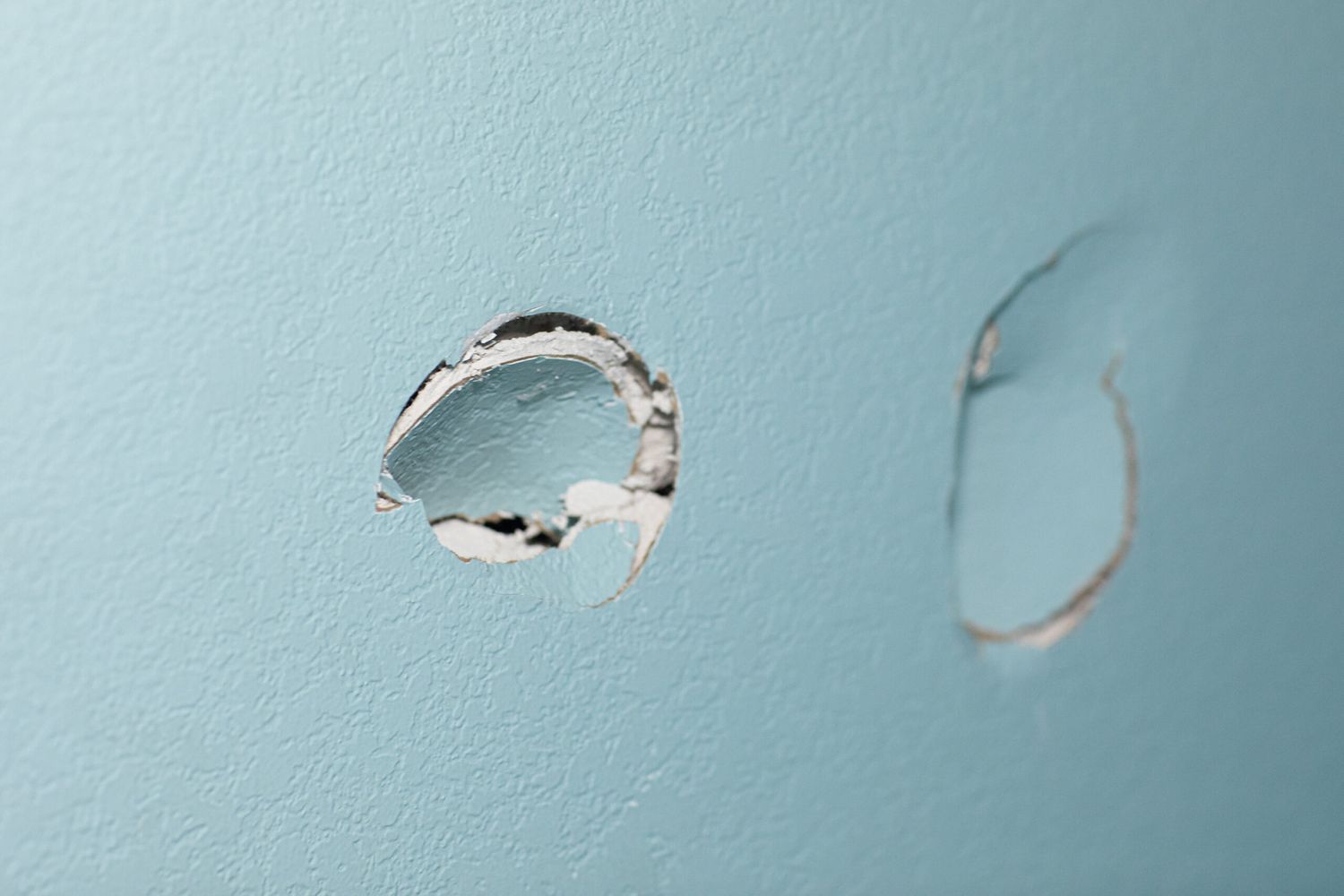
No matter how careful you are, if you live in a home long enough, you’ll probably eventually find yourself with some holes in the walls to patch. And if a small section of wall is really badly stained or damaged, you’ll have to cut out the affected area and cover the hole with a drywall patch.
Fixing holes in drywall is a relatively easy DIY project that often doesn’t require a lot of time or experience. Wall-repair kits, available at home centers and hardware stores, can make the process easier. How you should proceed with your repair depends on the size of the hole you have to fix. Read our step-by-step guide to learn how to fix a hole in drywall.
Tools and Materials for Fixing Holes
Below is a list of the necessary tools and materials you’ll need to complete the project, depending on the size of the drywall hole.
- Two 1 x 3 boards
- Cloth
- Construction adhesive
- Drill
- Drywall knife
- Drywall screws
- Paintbrush
- Primer
- Putty knife
- Repair kit (fiberglass mesh or galvanized steel)
- Sandpaper
- Scrap drywall
- Spackling or joint compound
- Tape measure
- Touch-up paint
How To Fill a Small Hole
Small holes are the easiest to fix. Depending on the size, all you’ll need is a putty knife and spackling or joint compound, or a repair kit you can buy from any home improvement store or online. These kits typically include spackle, wall patches, a putty knife, and sandpaper.
Fix Tiny Nail and Screw Holes:
Tiny nail and screw holes are a quick fix. Use a putty knife to fill them with spackling or wall joint compound. Allow the area to dry, then sand lightly. Anything larger must be covered with a bridging material for strength before applying the patching compound.
Fix Holes Between 1/2 and 1 1/2 Inches in Diameter:
To repair drywall holes between 1/2 and 1 1/2 inches in diameter, bridge the gap with a piece of adhesive-backed fiberglass mesh. We used a repair kit from Wal-Board Tools ($6.48) that includes a pair of 8-by-8-inch mesh squares.
Use the Kit in 4 Steps:
- Hand-sand around the edges of the hole to smooth any rough spots. Wipe off any sanding dust with a damp cloth.
- Cut a piece of fiberglass mesh patch to overlap the hole by at least 1 inch on all sides. Peel off the paper backing and press the mesh tape to the wall.
- Use a 6-inch drywall knife to smear spackling compound through the mesh and over each hole.
- Let dry overnight, sand lightly, then apply a second thin layer. If needed, apply a third skim coat after the second one dries.
How To Fix a Medium-Size Hole
You’ll need a patch kit that includes stronger materials to repair a medium-sized home in drywall. Kits for repairing larger holes are also available at most hardware stores or online.
Holes Between 1 1/2 and 6 Inches in Diameter
Holes ranging from 1 1/2 to 6 inches in diameter must be bridged with an even stronger, more rigid material. We used a 4-by-4-inch galvanized steel patch from Homax ($5.37) to repair a 2 1/2-inch diameter puncture caused by a doorknob. The company also makes 6-by-6-inch ($5) and 8-by-8-inch (under $8.39) patches. The patch comes stuck to a 6-inch-square piece of adhesive-backed fiberglass mesh.
Install the Patch in 3 Steps:
- Peel off the backing sheet from the metal patch to expose the adhesive. Then press the self-adhesive patch to the wall.
- Spread on three coats of compound, letting each dry thoroughly before applying the next.
- The final coat should be at least 12 inches square so that the compound at the edges of the patch feathers out to the surrounding wall.
How To Patch a Large Hole
Larger holes require a little more work, but many homeowners are likely capable of this DIY job. You’ll need to pick up some 1 x 3 boards, paint and primer, a paintbrush, sandpaper, construction adhesive, and drywall at your local home improvement store. You’ll also need a drill, drywall screws, and joint compound.
Fix Holes Larger Than 6 Inches in Diameter
Repairing a hole that’s larger than 6 inches diameter may seem like a real challenge—but all you need are two short 1 x 3 boards and a scrap piece of drywall.
Patch a Big Hole in 9 Steps:
- Cut the ragged edge of the hole into a neat square or rectangle—using a drywall saw is ideal.
- Slip one of the 1 x 3 boards into the wall cavity and screw it to one edge of the cutout, being sure it overlaps into the hole by 1 1/4 inches.
- Attach the second 1 × 3 to the opposite side of the cutout.
- After cutting a piece of drywall to fit into the cutout, apply a bead of construction adhesive to the face of each 1 × 3.
- Secure the patch to the 1 x 3s with 1 1/4-inch-long drywall screws.
- Spread a thick coat of joint compound around the edges of the patch, then gradually feather the edges to blend the patch into the wall.
- Use the drywall knife to firmly press paper tape into the compound to hide the joints.
- After the compound has dried completely, sand it smooth and apply at least two more thin coats of compound.
- Lightly sand the final coat, prime the area, and brush on two coats of touch-up paint, letting the first dry thoroughly before applying the second. Make sure you use the same color paint as the rest of the wall so that you can hide the patched area.
Our Conclusion
Most homeowners can tackle drywall repair, whether it’s small nail holes and screw holes or a 6-inch gaping hole. Unless you have a spare repair kit or spackling, you may need to pick up some supplies at a nearby home improvement store. Larger holes will require slightly more prep work. Fixing a smaller hole usually costs between $10 to $55, and the cost to repair larger holes shouldn’t exceed $100.*
* Costs in this section sourced from Angi.
Need help with home repairs? Find a trusted home warranty provider in your area.
