
Back in the 1950s, butterfly roofs and vertical siding made a conspicuous statement about the home of the future. But even as the Modernist movement was radically changing the outward appearance of houses, underneath, many of them were still framed the conventional way, with old-fashioned sawn lumber. That’s the way it was with this season’s TOH TV Cambridge project house.
Today, even in traditional-looking homes, the “futuristic” stuff is often the framing itself. And there’s a new language to go with it. Besides understanding the true sizes of dimensional lumber—that a 2×4 is really about 1 1/2 by 3 1/2—carpenters now need to know a host of abbreviations: LVL, OSB, I-joist.
They also need to understand more about load and force as strong, efficient engineered woods and steel replace milled stock. Then there are the countless metal ties and brackets—more than 1,700 hangers alone—they’ll encounter. A house isn’t just wood and nails anymore.
A look at the framing done at the Cambridge house by TOH general contractor Tom Silva and his crew gives you a good idea of what some of these newer materials can do: allow for higher ceilings, larger open spaces, and even cantilevered rooms.
Dimensional Lumber Gives Your House Its Basic Shape
Engineered 2×4, 2×6 & More
Advances in building technology haven’t eliminated the need for good old sawn lumber—2x4s, 2x6s, 1x strapping, and the like. It’s still the dominant material in a house’s skeleton. Dimensional lumber (as distinct from lumber made from fibers or veneers) has good compressive strength—it stands up well to force pressing down on it when it’s vertical—so it makes excellent studs.
But it’s the least expensive framing material, so it’s also used for the horizontal parts of a wall frame, such as the sole plates at the bottom, the top plates, and the blocking between studs. Interior walls are predominantly made from 2x4s, which are deep enough to fit plumbing and wiring between the studs, while 2x6s make better exterior walls because they leave more space for insulation.
Most dimensional lumber is milled from softwoods like spruce, fir, and pine, then kiln-dried for stability. There are stronger versions, such as straight-grain fir. When combined with metal ties it can be turned on the flat, with its broad face parallel to the wall, wherever there’s limited space for a stud. Tom used fir in this manner to frame a cavity for a pocket door.
“It costs twice as much, but it won’t ever bend or warp,” he says. “That’s important, because over time, if the stud curves, the door will scrape.”
Engineered Lumber: Strong Beams That Allow For Open Spaces With No Posts
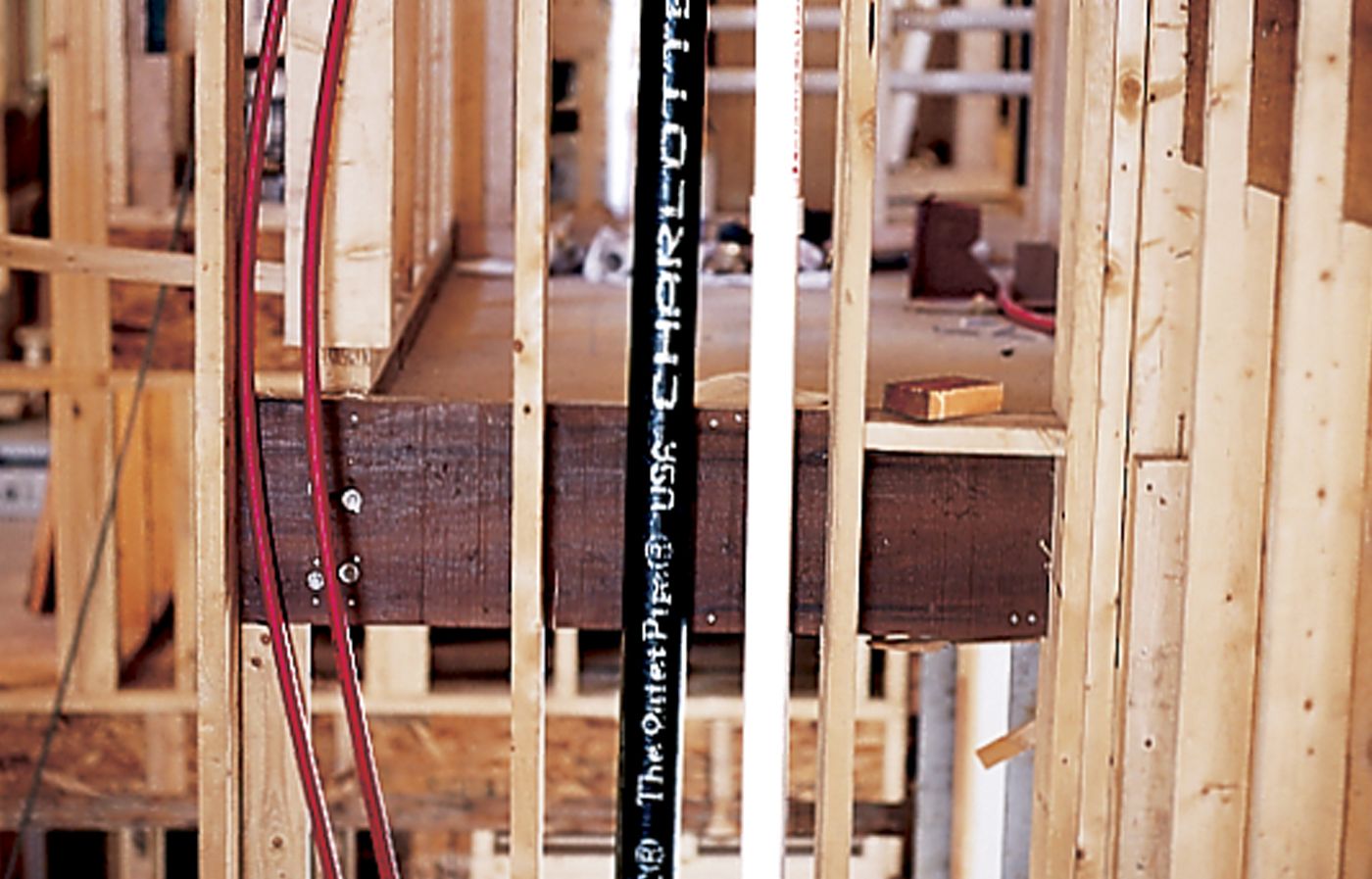
Engineered lumber is made from wood veneers and particles, glues, and resins to create large structural elements that virtually never fail if used correctly. Manufactured in a controlled environment, the load factors for these materials are precisely calculated for every size. Engineered lumber also saves trees by using more of the whole tree—typically 30 percent more than sawn lumber—so fewer need to be cut down.
LVL Beams & I-Joists
The two most common engineered wood products used in modern framing are LVL beams and I-joists. Laminated veneer lumber (LVL) is just what it sounds like: wood veneers (typically poplar, pine, or fir) laminated together under heat and pressure with a moisture-resistant resin.
Because the grains all run in the same direction, LVLs are extremely stiff and stable. They come in thicknesses up to 3 1/2 inches, depths from 3 1/2 to 24 inches, and lengths as much as 60 feet.
Because of their tensile strength—meaning they can hold up a lot of weight along their length without sagging—LVLs make great door and window headers, stair stringers, ridge beams, cantilevered roof supports, and other carrying beams. And as they have the ability to span long, open spaces, LVLs can eliminate the need for posts in basements and garages.
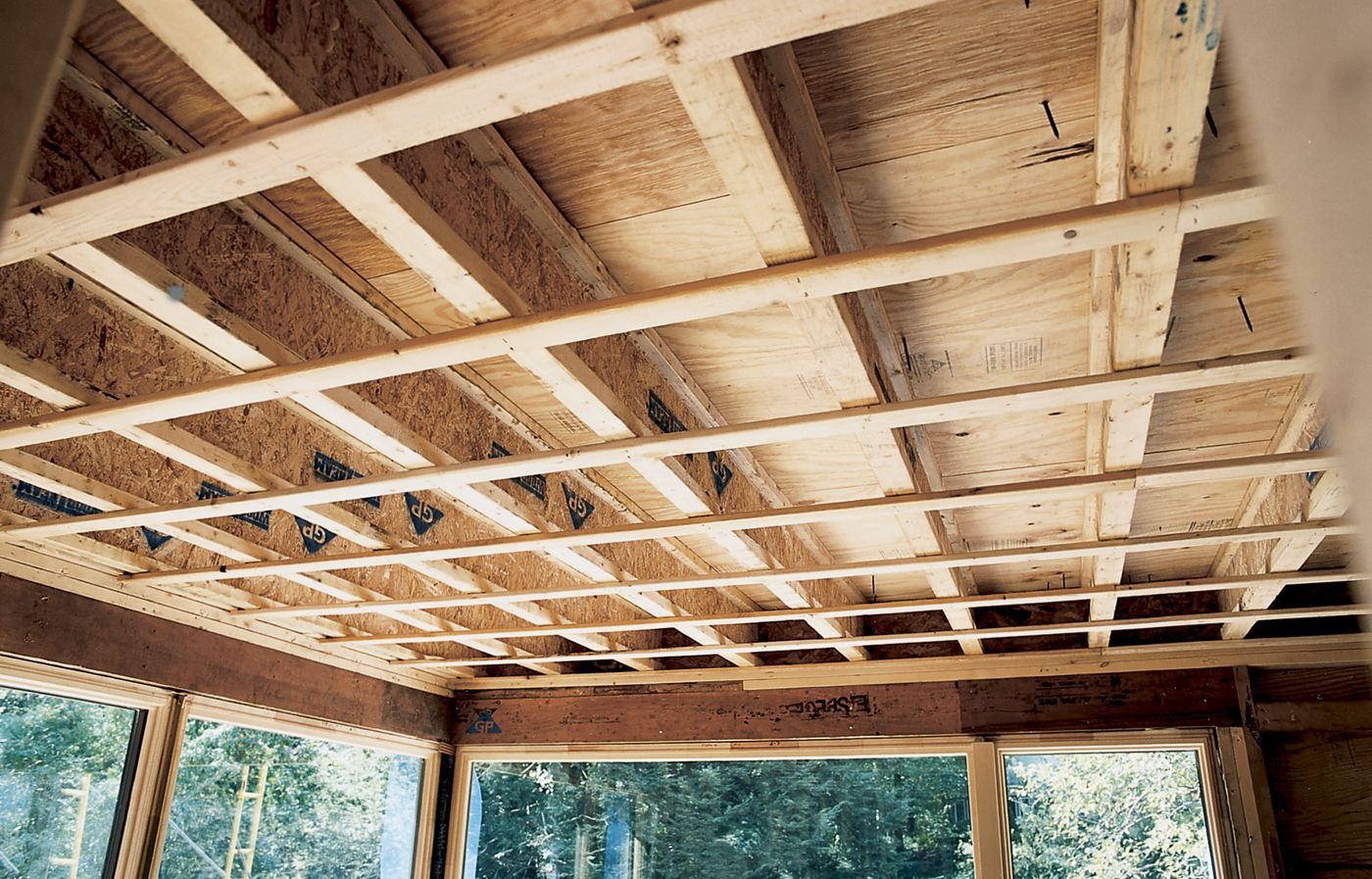
I-joists are engineered beams made in an I shape. They are made up of a vertical web of dense oriented strand board (OSB) in the middle, with a horizontal flange of dimensional lumber or LVL above and below. They’re used for joists and rafters, because they’re lighter than sawn lumber and able to span greater distances.
And unlike lumber, they can take large holes for plumbing and ductwork without compromising strength. All these factors add up to higher ceilings, because a smaller I-joist will carry the load of a deeper one made from dimensional lumber, and systems don’t need to run under the ceilings in added framed channels, or soffits.
The flanges in I-joists are also wide—up to 3 1/2 inches—providing more room to glue and nail subflooring. “Any time you get more fastening surface, your floor will be stronger,” says Tom, who makes sure to use stiff I-joists under floors with rigid finish materials like tile or stone.
The benefit of engineered lumber is its stability and strength. But Mike O’Day, manager of engineered lumber for Georgia-Pacific, one of the largest manufacturers of building products, says you can’t generalize about the strength of engineered wood versus dimensional lumber—in part because the latter is so varied in quality.
“The real advantage,” says O’Day, “is not so much that engineered wood is stronger, although in many cases it is, but that it is more consistent and predictable.”
Cost Comparison
It’s worth noting that engineered lumber is generally more costly than dimensional lumber. And there have been environmental concerns about the phenol formaldehyde binders used in most engineered-wood products, which can off-gas. Though these pieces are usually encapsulated behind wallboard, manufacturers have begun using a greener, formaldehyde-free binder called PMDI in a few products.
Sheet Goods: The Skin That Tightens Up a Frame & Keeps It Stable
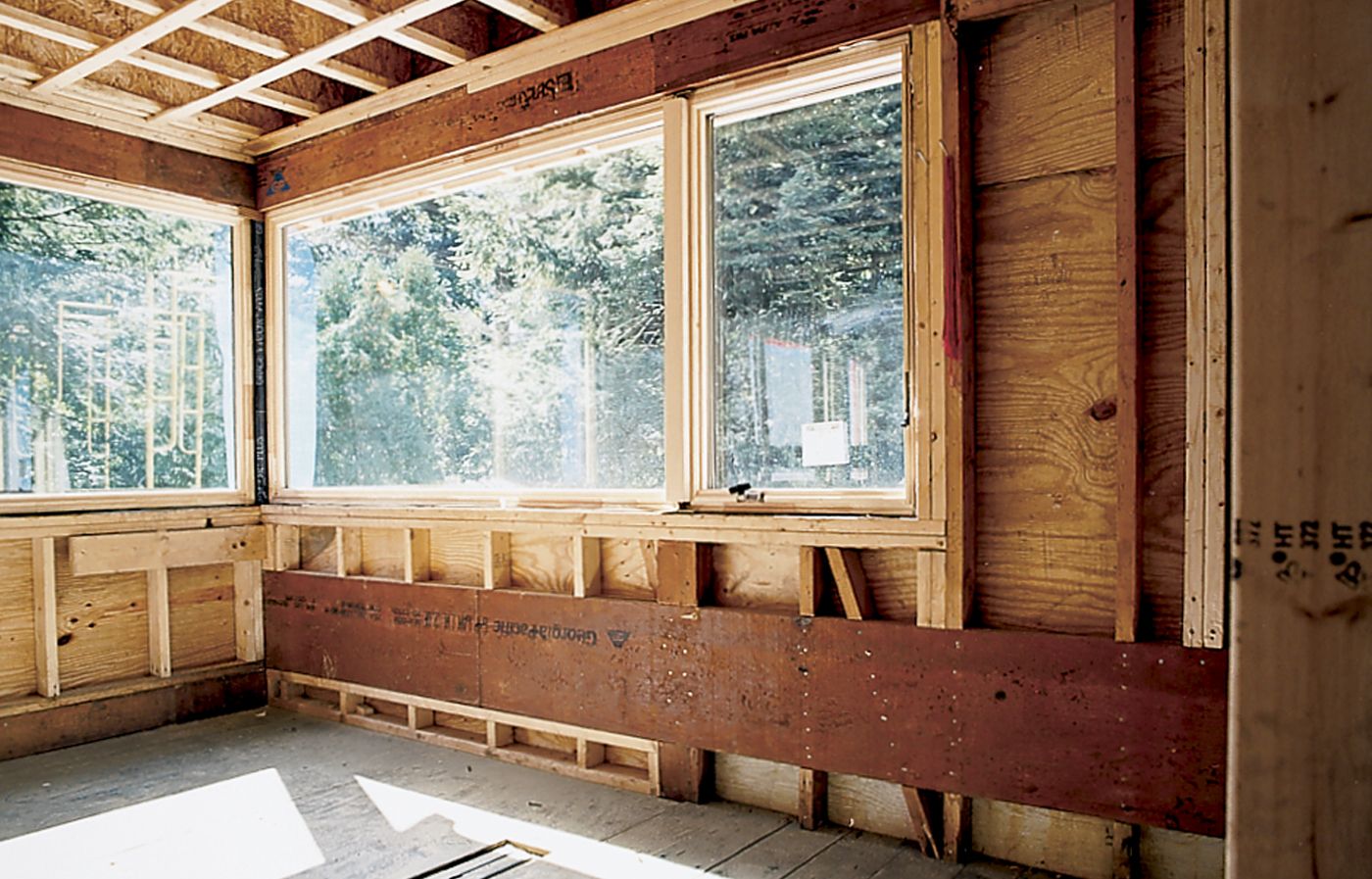
While dimensional lumber handles downward pressure, and engineered lumber braces against push/pull forces, sheets of plywood or oriented strand board (OSB) fight side-to-side movement by spanning and connecting framing members.
Less-expensive OSB is wood shavings glued together with resins. Plywood is thin sheets of veneer or “plys” glued together in layers (typically five), with the grains perpendicular to each other. This maximizes strength and minimizes shrinking and swelling, and makes plywood the stronger of the two. But both are used for exterior sheathing, subflooring, and sometimes even interior wallboard.
Tom uses plywood sheathing—minimum 5/8-inch and more often 3/4-inch—on the houses he works on. For extra strength, he glues down corner sheets and roof sheathing, as well as all floor sheets (he may use OSB here), which are tongue-and-groove for added strength. “I pay a lot of attention to lateral movement,” he says. “On a windy day, I don’t want a house to even creak once.”
Steel Bars & Connectors: Metal That Adds Strength Without Bulk
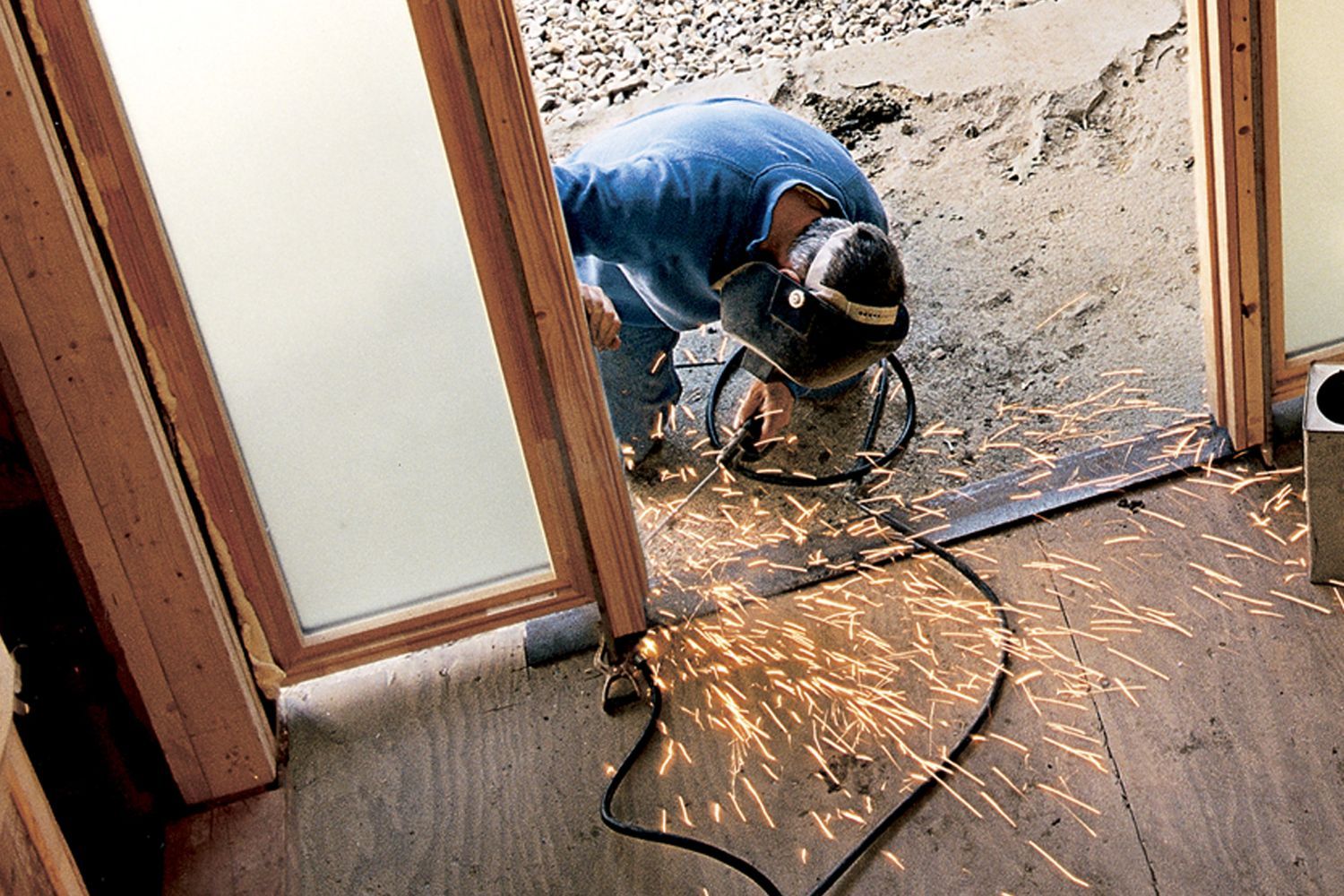
Steel might seem unlikely in residential framing, but it’s being used more and more to add strength where wood meets wood—especially when the job calls for major support in a tight space.
Steel has tensile strength, which makes it an excellent material for joists or carrying beams when paired with lumber in a “flitch” beam. A mere 1/2-inch-thick plate of steel bolted between two planks of wood can carry much bigger loads than wood alone, and thus the whole beam can be sized smaller.
“Sometimes every inch counts,” says Tom, who may use a flitch beam to eke out more headroom in a low-ceilinged space. In addition to flitches, steel is also used to make support posts and I-shaped beams (I-beams).
On a smaller scale, steel ties—joist hangers, rafter ties, and flat connectors—make for tight, strong joints between two framing members. In fact, many local codes now mandate using hurricane-rated ties to provide security against high winds or earthquakes. But even outside of the areas threatened by such disasters, high-tech ties—combined with the best framing materials for any given application—make for a solid house, built to last for generations.
Where to Find It
Architect:
Will Ruhl, AIA
Boston, MA
617-268-5479
Engineered Lumber:
Georgia-Pacific Corp.
Atlanta, GA
800-2884-5347
Metal Connectors:
Simpson Strong Tie
Simpson Manufacturing
Dublin, CA
800-999-5099
