
Project details
Skill
Cost
Estimated Time
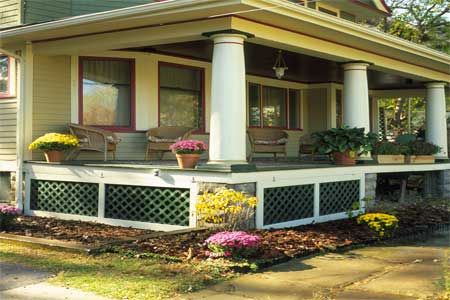
If your porch isn’t well maintained, the whole house looks shabby. Here you’ll learn how to handle one of the most common of all porch repairs: building a new lattice skirt. This enclosure conceals the framing while it also allows air to circulate under the porch floor, which keeps the framing dry and free of rot.
A skirt typically consists of a lattice panel set into a wood frame. In older homes, it’s often built of untreated pine or fir, neither of which is very resistant to decay and bugs. In time, the parts closest to the ground begin to rot and the decay spreads to the lattice. In regions that receive a lot of precipitation, wood rot can begin to appear in less than two years.
Occasionally, a porch skirting doesn’t have a framework and simply consists of a lattice screen attached directly to cleats nailed to the understructure framing. (The porch we worked on had this type of skirt.) While a frameless skirt is easy to install, it’s also susceptible to warping and damage because the lattice has very little support.
Here we built a durable new skirt using pressure-treated lumber and TuffBilt plastic lattice. We also opted for an unconventional installation method. Rather than permanently attach the frames, we hung them on hinges so the homeowners could use the space below the porch for storage. The swing-up frames also make it easy to crawl underneath the porch to repair the framing if needed.
The techniques used here can also be adapted for replacing lattice on a deck, fence, gate, privacy screen, or trellis.
How to Install Lattice Under Deck
1. Prep for installation
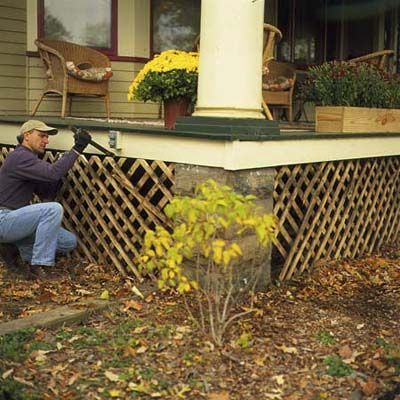
- Start by removing the old lattice from the porch with a flat pry bar. Be careful that you don’t damage the porch fascia or support columns.
- Measure the openings between the columns or posts. The completed frames must be a ½-inch narrower than the overall width and 1 inch shorter than the height.
2. Begin assembly
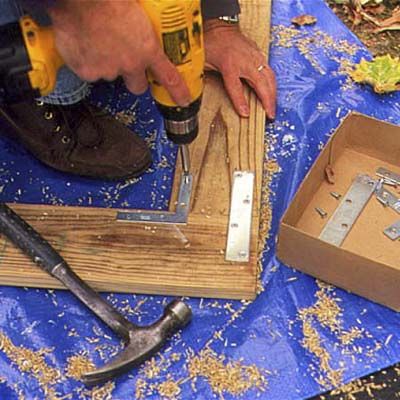
- Cut the frame parts to length and assemble them facedown on a flat surface. Strengthen the frame by installing a 6-inch mending plate and a 3½-inch flat corner brace at each corner joint.
- Position the hardware pieces about ¼ of an inch from the edge of the frame and secure them with 3/4-inch-long flathead screws
3. Connect the center stile, prime, and paint
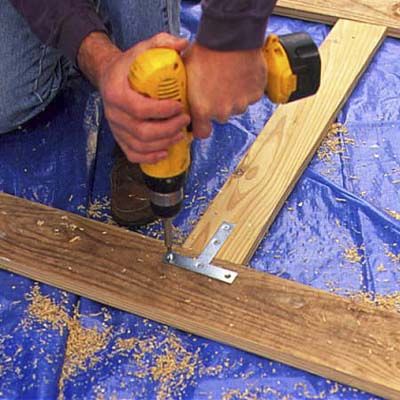
- Connect the center stile to the frame with two 4-inch T-plates. Be sure the leg of the T-shaped plate is centered on the 1×4 stile.
- Once the frames are assembled, apply a coat of primer, followed by two coats of gloss enamel trim paint.
4. Size the lattice panels
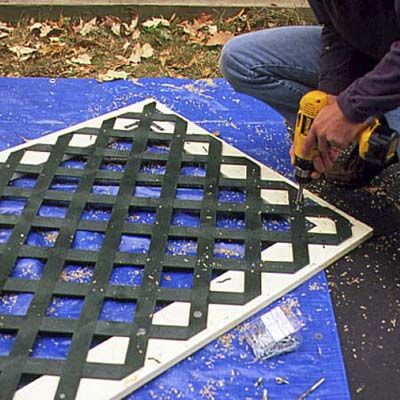
- Cut the lattice panels down to size using a sabre saw or circular saw. Lay the frames facedown and attach the lattice with 1-inch panhead screws driven through washers. Be sure to drill clearance holes slightly larger than the screw shanks so the lattice can expand and contract.
5. Secure the seam
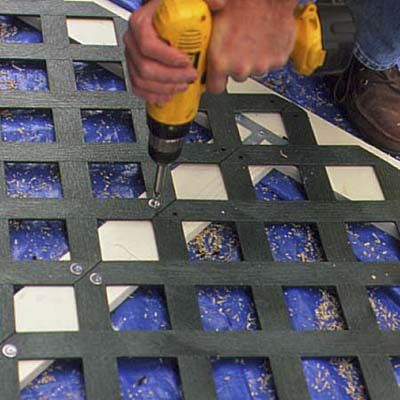
- Where two pieces of vinyl lattice meet at a center stile, secure the seam with two rows of 1-inch panhead screws.
6. Hang the framed-lattice panels
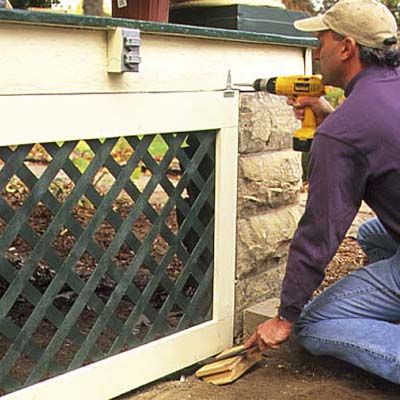
- Hang the framed-lattice panels from the porch with either 3- or 4-inch strap or T-hinges. Two hinges are sufficient for a panel that’s shorter than 8 feet, but use three hinges on one that’s longer.
- Screw the hinges to the frames first, then set the panels in the openings under the porch. Slip a pry bar under the panel and raise it up tight against the porch fascia. Use a drill/driver to screw the hinge to the porch.
- Check to make sure the panel swings up and down smoothly. If it drags on the ground, use a shovel or rake to remove some dirt from in front of the panel. If there’s a large gap beneath the panel, add soil, then smooth it out to create a consistent space between the panel and ground.
Tools
Tools & Materials
 Tape measure
- Hammer
- Drill/driver
- Flat pry bar
- Circular saw
- Garden rake