

Rick Roger’s two-story Georgian has stood for more than 80 years in the prosperous suburb of Evanston, Illinois, north of Chicago. With its columned portico, brick walls and ivy-covered facade, his house is the image of prewar solidity. Up close, the walls tell another story.
Old House, Old Walls
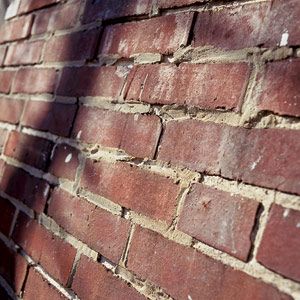
Between the brick, slapdash patches of gray mortar clash with the original white. In some places, the brick face has begun to flake off—a sign that water is getting in, freezing and slowly turning the hard red clay into dust. A dozen 3-foot-long cracks radiate from the windows on the north side, leaving the wall open to water infiltration. Anxious to find out what has gone wrong, Rogers called Mario Machnicki, a mason who specializes in fixing brick and stone walls.
The Problem: Masonry Cement
Several weeks later, after a visit to examine the walls, Mario and his younger brother, John, arrive in their red pickup, ready to work. The message at the Rogers house is loud and clear: The mortar is killing it. Not the original mortar, a relatively soft mix of lime and sand, but the previous patch job, which used masonry cement. The old lime-based mortar had been a perfect partner for the soft, porous brick, flexing to accommodate the brick’s slight expansion and contraction. Like all mortars, however, it slowly eroded, and after 60 or 70 years the weathered portion was chiseled out and replaced, a process called repointing (or pointing).
Unfortunately for this wall, masonry practices underwent a tectonic shift in the 1930s. Brick became harder and more rigid, as did mortar. With the ready availability of portland cement, a material so hard and so impervious to water that it is used to plug leaks in basements, masons abandoned time-consuming lime-based mortars, which set so slowly that no more than seven courses could be done in a day. Instead, bricklayers adopted fast-setting masonry cement: sand and ground limestone blended together with as much as 65 percent portland cement.
That modern mix was the unyielding cement the previous masons had slapped on the Rogers house joints. Once it cured, the delicate give-and-take of brick and mortar was replaced by a protracted battle-which the old brick was losing. The cement dammed the joints, trapping moisture inside the brick. In winter, the waterlogged walls froze and cracked, allowing still more water to penetrate. In summer, as the brick tried to expand, its protective fire-skin literally popped off. “The cement mortar is not helping the wall; it is actually hurting the wall,” says Mario Machnicki.
Americans’ reliance on masonry cement surprised him when he arrived here from Poland in 1977. He grew up building brick houses without a single grain of cement. The mortar he used contained simply three parts sand to one part lime putty, the ratio established in 10 B.C. by the great Roman military engineer Vitruvius. These days, he buys 5-gallon buckets of custom-blended lime mortar, which cost about $8 and hold enough to repoint the ⅜-inch joints on 60 square feet of wall.
For the Rogers house, he had the original mortar analyzed so he could order the same recipe. The assay revealed the proportion of lime to sand, the size and color of the sand grains and the compressive strength of the brick. The analysis is expensive ($500), but he says he prefers to “know exactly what’s in it, rather than guess.” Even without the test, he gets a good idea of mortar type just from knowing the year a house was built. He double-checks his hunches by chiseling out a small piece of mortar and dropping it on the sidewalk. A piece containing a lot of cement makes a high-pitched ring; a chunk containing mostly lime makes a muffled thud.
How to Repoint Brick & The Cost
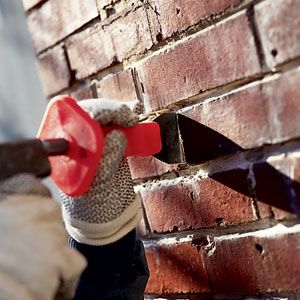
The right repointing technique ensures the work will last. At the Rogers house, John Machnicki takes chisel and hammer and starts raking the joints clean to a depth of 1 inch. He takes care not to break the brick’s hard fire-skin, which protects the relatively soft core.
Chiseling is tedious, painstaking and, for cement-covered joints, frustratingly slow. It’s easy to see why repointing by hand costs as much as $25 a square foot. Using an electric grinder with a diamond-tipped blade can cut the cost to $5 per square foot, as long as the joints are more than ½-inch wide. But grinders must be handled with skill and restraint—on horizontal joints only, never on vertical joints—because these powerful tools are notorious for damaging brick. The Machnickis won’t use them at all when restoring historic buildings.
Tuck-Pointing vs Repointing
Homeowners who try to save money by tuck-pointing (patching new mortar over old without chiseling) are throwing their money away, Mario Machnicki says. At best, tuck-pointing leaves a weak connection between old and new mortar layers; at worst, it makes joints wider and more susceptible to water infiltration.
When John Machnicki finishes hand-chiseling, he squares the cut and cleans dust out of the joints with a compressor-powered pneumatic chisel. “The mortar bonds better to the clean, chiseled surface of the brick,” his brother says. Mortar can’t bond to paint or wood so, between brick and window casings, he leaves a gap to be filled later with caulk. “That’s a housepainter’s job, not a mason’s.”
Before the younger Machnicki refills a joint, he mists the wall with water to keep the mortar from drying too quickly. Then he scoops a glob of the sticky gray mix out of a bucket and onto his plasterer’s hawk. Holding the hawk up to the wall, he scrapes fresh mortar into the joint with a narrow tuck-pointing trowel. He doesn’t fill the fresh mortar into the joint in one pass. Instead, he makes three to four passes, each time pressing in a thin layer of mortar. When it becomes thumbprint-firm, anywhere from 30 minutes to 24 hours later, he cuts off any protrusions with a pointing trowel. A few whacks with the bristle end of a stiff brush, and the joints match the weathered look of the originals.
When finished, the new patches at the Rogers house are undetectable. As always, both Machnickis are proud of that, although it once caused them some trouble. Mario Machnicki recalls: “We sent a bill to a customer after one repointing job, and he complained, ‘You haven’t even done the work yet!'”
A History Lesson on Limestone
Before the 1870s, when portland cement mortar became commercially available, most masonry structures—the Egyptian pyramids included—were built using only lime and sand. “It’s the best mortar ever developed,” says Tim Meek, a leading Scottish authority on repointing historic buildings. The key to its superiority is the lime itself. (The ground-up limestone commonly added to masonry cement is something else entirely.) This is kiln-fired limestone, slaked for up to a year, until it turns into custard-smooth brilliantly white putty. Blended with sand, the putty makes a mortar that’s permeable to water vapor and flexes with changes in temperature. If hairline cracks form, rain will wash some of the surrounding lime into the gaps, repairing them. Lime mixes are easy to chisel out when the time comes to repoint although, as Meek points out, that time may be a long way off: “I’ve seen 600-year-old castles with their original mortar, and they’re in fine shape.”

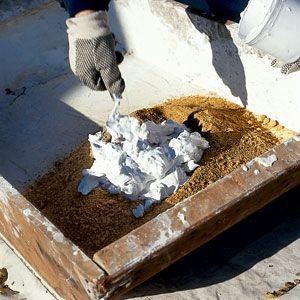
Lime putty comes in one color—white—but mortar comes in many shades and textures. If only color is important, the putty can be tinted in a range of hues using iron-oxide pigments, above. To match a mortar’s texture as well as color perfectly, some companies keep stocks of sand, which comes in as many shades as there are beaches. These companies analyze mortar to determine the type of sand they should add to replicate the recipe for the original mortar. They may not be able to track down the exact pit that supplied the original sand, but they can get close.
Repointing Rules
Whenever mortar has lost ¼ inch of its original depth, it’s time to get out the chisel and go to work. Thoroughly rake out and clean joints to a depth twice the width of the joint.
Do not chip, cut or remove the brick’s fire-skin, which will accelerate decay.
Make sure the brick is stronger than the mortar. In general, houses built before 1930 have softer brick, which makes them likely candidates for old-style lime mortars. To know for sure, have an engineering lab analyze a brick for compressive strength.
Repoint only when temperatures remain between 40 and 90 degrees Fahrenheit, even at night. Cold makes mortar brittle, while heat dries it out and prevents hardening.
Keep fresh lime mortar damp for at least 3 days so it can harden before it dries. Taping plastic sheets over repointed areas will slow evaporation. After the sheets are removed, hose the wall periodically during dry spells to speed hardening.
