
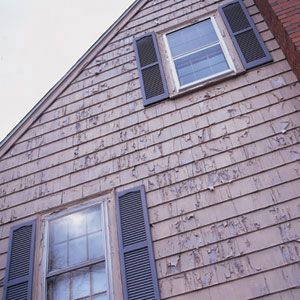
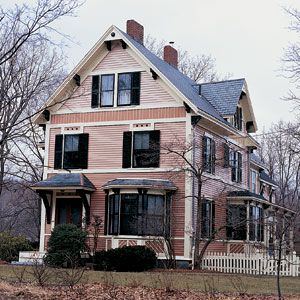
This Old House painter John Dee calls his neighbors Robert and Andrea Bowler “the epitome of diligent homeowners.” They bought their postwar Colonial in May two years ago, and a month later Andrea was down at the local hardware store, picking out new beige paint to lighten up the gloomy exterior. Soon Robert was up on the ladder, hard at work. “It wasn’t easy,” he says. “I scraped the whole house, rented a water gun, primed everything. I put two coats of paint over that. I did it when I got home from work, I did it on Saturdays. It took me the whole summer. It looked so good.” But within a year, as the Bowlers watched in horror, their labor-intensive paint job — and everything underneath — was flaking off in leathery sheets. The paint detached with such determination that some chips were embedded with cedar splinters from the underlying siding. Layers of paint that had bonded to the house for decades came loose. “You can generally tell if you have a house that is going to peel if you probe around a bit,” Dee says. “But my neighbors had no previous paint problems, and they went by the book.” Dee has understandable sympathy for the Bowlers: Not long after his house was repainted, it began peeling so badly the south wall looked like a head of hair after a botched perm. “It’s a total blowout,” he says. About one in 10 paint job goes awry, says David Chupka, a technical manager for the Sherwin Williams Co. Often it’s because of cutting corners — not sanding, not scrubbing, painting just before a storm,ignoring long-term moisture penetration. But people who own old homes can do everything they’re told by paint salesmen and follow labels devotedly and still wind up with paint that peels. If they’ve hired someone to do the work, at prices that can rival the cost of a new car, peeling paint can begin to look like paper dollars floating off with each breeze.
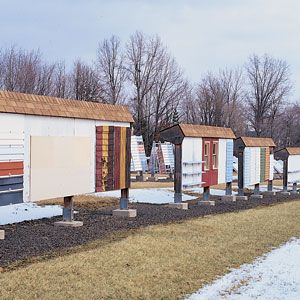
William C. Feist thinks he knows why this happens and how to deal with peeling paint. The problem can occur when an old house with multiple layers of oil-base paint is coated with a modern water-base paint, says Feist who headed the federal government’s house paint research program for 20 years. “The homeowners decide to upgrade and put on a good latex paint. But that last coat of a new type of paint can be sufficient to cause catastrophic failure, often right down to bare wood. ” When people in the paint industry have a problem they often consult with the chemical company that supplies them with the ingredients they put in their cans. In the United States, almost all paint companies turn to Rohm & Haas and its Paint Quality Institute in Spring House, Pennsylvania, near Philadelphia. There, in a six-acre field draped with two miles of odd-looking fences, 25,000 paint samples are in a contest with time, weather and the sun. On a blustery day last winter, the institute’s technical director, Walter J. Gozdan, led the way through this maze, happy to talk about the intricacies of what people in the paint industry like to call coatings.
Essentially, he says, there are two kinds of house paint: oil (also called alkyd because of the alcohols and acids used to make a synthetic oil) and so-called latex (which, it turns out, has no rubber in it). Both consist of three main components: a pigment, a binder that glues the pigment to a surface as the paint dries and a solvent that makes the mixture loose enough to brush on. Oil paint forms a tough plastic film as the binder reacts with oxygen in the air. The binder can be a natural oil, such as linseed squeezed out of flaxseed, or oil modified with alkyds. Latex paint forms a flexible film as water evaporates and the once-floating spheres of binder and pigment move closer together and fuse. Latex paint was inverted at the end of World War II using synthetic rubber as the binder. Today the binder is most often a pure acrylic, a vinyl-acrylic or a vinyl acetate. The critical difference between oil and latex paints is that they do not cure in the same way. Oil paint never stops curing. As it ages, it continues to oxidize, becoming more and more brittle. Latex cures in about two weeks and stays pliable. Oil paint generally adheres better to problem surfaces because the oils are small enough to seep into the wood or microscopic openings in old, even chalky paint. The resins in latex paint are generally too big to seep into anything. But that can be advantageous. The gaps between the larger particles in latex paint allow water vapor to pass through. This makes latex less likely to peel from homes with excessive interior moisture.

New Paint and Old Houses
As Gozdan pauses near the middle of the paint maze, he points out how all this theory translates into reality. At a series of mock-ups of window frames coated with oil paint, he jabs a finger at stringy hairline cracks on some of the wood and deeper, squarish cracks on others. Both, he says, are evidence that the oil paint has become too brittle to keep up with the expansion and contraction of the wood. Then Gozdan walks to a nearby section where dozens of three-foot pine boards are painted with white latex from a variety of manufacturers. Some boards are gleaming, but after just three years outside, others are almost bare — a sign, he says, that manufacturers tired to cut corners by using cheap ingredients. No, Gozdan won’t say which brand is which. That’s not the point anyway. The lessons here are that latex outperforms oil and the expensive all-acrylic latex works better than less expensive latex with vinyl acrylics. “The most expensive paint,” Gozdan says, “is the cheapest in the long run.” Rohm & Haas has a vested interest in this position: Paint gave it a postwar market for acrylics, which had been going by the ton into Plexiglas airplane windows. Still, one of the few independent paint research centers in the country, the U.S. government’s Forest Products Laboratory in Madison, Wisconsin, agrees. The lab compared oil and latex paints on its own test fences strung across a windy hillside. “We have twenty-year-old latex that looks as good as if it were new,” says chemist Mark T. Knaebe. The side of a typical house, he says, should get more protection from two coats of latex over a primer coat than it would from two coats of modern oil paint over a primer. No wonder paint salespeople tout the benefits of latex. But what many don’t realize is that all the tests that find latex to be superior have been done by painting over bare wood clapboards or over wood that had only one or two coats of old paint. No one has tested what works best over many layers of old paint. Most houses built before 1950, as well as many newer ones, are covered with multiple layers of oil paint. When Gozdan is asked how this might affect the institute’s recommendations, his answer is surprising: “I would never use latex over multiple coats of oil paint. You stand a chance of peeling off all the paint if you switch.” Latex paint can literally pull old oil paint off the house, he says. “I’ve seen houses where the paint has come off in four-by-eight-foot sheets.”
When a flexible layer of latex bonds on top of brittle oil paint the old paint becomes a thin rope in a tug-of-war. As sunshine hits the wall, the wood and the latex can expand. But the oil paint in the middle is brittle. Now pulled with double force, it either cracks or loosens its grip on the wood underneath. “The latex tends to accelerate the paint loss,” says Carl Minchew, director of technical services for Benjamin Moore & Co. Gary Barrett, director of technical services for the Painting & Decorating Contractors of America, says the stress on the old oil paint is greatest during the few weeks it takes latex to cure, although the results may take months or years to become fully evident. “It’s the shrink factor of latex,” Barrett says. “It has to coalesce, or it can’t cure.” The force of this effect varies. Often houses with layers of old oil paint can be successfully covered with modern latex. But when it doesn’t work, the results may be disastrous. “It’s very unpredictable,” says John G. Stauffer, director of the Paint Quality Institute. To be safe, Gozdan and Stauffer say, people who have houses with more than five layers of oil paint are best to stick with oil. Many others in the industry are not so cautious. Homeowners can safely recoat even many layers of oil paint with latex as long as the old paint is adhering well and is in good shape, says David Maurer, manager of product development and color delivery for the Gildden Co., which sold the first latex paint in 1948. “If, categorically, latex going over oil was a problem, I don’t think we’d have any latex paint, or we’d have latex limited to new construction, and that’s certainly not the case, ” he says. “But I will say that if you have a lost of loosely adhering — and it is common on older houses to see oil paints fractured right down to the surface — latex paints can hasten the demise by putting pressure on the poor oil paint. I think oil paint makes a better Band-Aid,” Not long ago, a friend of Maurer’s sought advice on how to repaint an old house with wood shakes. “It was the old oil syndrome,” Maurer says. The paint was thick and cracking, and the options for dealing with peeling paint like this were not good: Spend a lot of money stripping off all the paint or spend less money for a repainting that wouldn’t last. “I told him the good answer was to remove it all, but the short-term answer was to put another layer of oil on top. At least he wouldn’t be creating a new problem. He’d just be stalling the inevitable.” To stall the inevitable as long as possible, homeowners can do periodic touch-ups with oil paint instead of recoats. The National Park Service, custodian of many old houses, has found that homeowners have more time to play with than they might think. Oil paint is most likely to crack, the service says, when it is more than a sixteenth of an inch thick, the equivalent of 16 to 30 coats. Homeowners who stick with oil may find the paint thicker and not as durable as it once was. Many manufacturers have changed their alkyd formulas to meet clean-air rules in effect in six states. But even if similar rules take effect nationwide next year, as expected, it still will be possible — and legal — to buy oil paint the way it used to be made. Oddly enough, manufacturers can continue to sell high-solvent paint simply by relabeling it “quick-dry enamel,” “industrial maintenance coating” or “marine paint.” Manufacturers can also sell high-solvent oil paint by the quart, although buying it this way instead of by the gallon typically doubles the cost. And top-quality but expensive oil paint that meets most of the clean-air rules is available from several European manufacturers who, unlike their US counterparts, have continued to invest research money in oil formulas. One company, Fine Paints of Europe, sells a “problem house” oil paint formulated to allow water vapor to pass through. Eventually, every house painted with oil will peel, says Minchew of Benjamin Moore, “because that’s what oil paints do. They continue to oxidize and get brittle.” Once a house reaches this point, he says, owners have two choices for dealing with peeling paint: first they can scrape off all the peeling paint, prime the bare spots, and repaint with latex. Areas that weren’t scraped bare will then peel, and the owners can repeat the process until eventually they have a house entirely covered in latex paint that sticks. Second, they can choose a faster, less ugly method: Strip the house down to bare wood and start over, either with latex paint or a semi-transparent oil stain. (These stains don’t form a film, so there’s nothing to peel.) Unfortunately, the best solution — stripping and staring over — is also the most expensive, In fact, it can be so expensive that new siding may seem like a better option. The expense may even make the most faithful old-house lover consider the unthinkable: vinyl siding. When Dee worked out the numbers for his house, he discovered it would cost only slightly more to rip off all the old shingles, nail up new ones and repaint. Vinyl siding was even cheaper. “Maybe that’s the best solution,” he says.
Six Signs of Paint Failure
When paint isn’t the problem Old age doesn’t always deserve the blame when paint cracks and peels. When moisture gets behind siding, it can literally push paint off the front. Read the existing paint for clues:
- Bulges or flakes at the top of a wall point to gutter or roof leaks; they should be found and fixed.
- Paint peeling on a wall next to a bathroom means condensation on the back of siding is being drawn through the wood when sunshine warms the wall. Install an exhaust fan vented to the outside.
- If window trim alone is peeling, pry off trim boards and plug gaps around the frame with a low-expansion foam sealant.
- If an entire wall is peeling, the siding may need better ventilation. One solution is to slip eighth-of-an-inch thick wedges under the lower edge of each board or shingle. One paint company sells plastic snap-off devices for this purpose. Do not caulk the bottom edge of clapboards.
A Perfect Paint Job
Spring is a great time to repaint, says Mark T. Knaebe, a chemist at the Forest Products Laboratory in Madison, Wisconsin. “I like it because you can be fairly sure you’ll finish the job before it gets too cold.” As co-author of “Finishes for Exterior Wood,” a book summarizing the lab’s 75 years of paint research, Knaebe knows a quality job takes time. He recommends starting with a quick test to determine the extent of the work. First, choose an inconspicuous place where the paint is worst. Clean the surface, let it dry and paint a small patch. The next day, press on a Band-Aid and then quickly pull it off. If the tape is clean, it’s safe to repaint after scrubbing the whole house. If the tape pulls off all the paint down to bare wood, the house needs to be stripped before it’s repainted. If just new paint comes off, the old paint is too chalky and you’ll have to coat the whole house with an oil primer first. For houses with some flaking but not enough to require stripping, remove loose paint with a scraper and a power washer, taking appropriate precautions if you suspect the old paint contains lead. Sand all bare wood and exposed paint edges or the new paint will be thin there and will chip in no time. Scrub the walls with water and kill any mildew by using a solution of one par household bleach to three parts water. Rinse and let the wood dry.
Most painters would simply prime and then paint at this point, but Knaebe recommends coating bare spots with a water-repellent preservative specifically labeled as compatible with paint. The repellent will limit shrinking and swelling of the siding due to moisture. Three sunny days later, you can prime the bare spots or coat the whole house. (If you’ve stripped all the paint, latex primer is recommended.) Apply the finish coat soon. Soap-like compounds can form on oil primers in as little as two weeks. If there is a longer delay, scrub and rinse before applying the top coat. Two coats will probably be needed with latex, Knaebe says. Before painting, check the air temperature and the weather forecast and make sure they’re compatible with the weather guidelines on the label. Weather that is too hot, too cold, too humid or too windy can undermine the best prep work.
