
Rain gutters aren’t very exciting. You probably never even notice yours until something goes wrong with them. And then it’s the wrong kind of excitement.
Gutters and downspouts collect and carry away rainwater that would otherwise run off the roof, splash down and erode the soil and stain the siding. More important, gutters and downspouts form the first line of defense against a wet basement or crawl space: If you let water collect along the foundation, hydrostatic pressure will build, and even the best gutters can become damaged. When that happens, water will eventually find its way inside the house. It’s equally important to keep the ground around a hillside home dry. For these reasons it’s important that your gutters are in proper working order. Here, we’ll show you how to patch a hole, seal a leaky corner joint and secure a gutter that’s pulled away from the house. Fix these problems as soon as they occur and your gutters will work more effectively and last many years longer.
Patching a hole
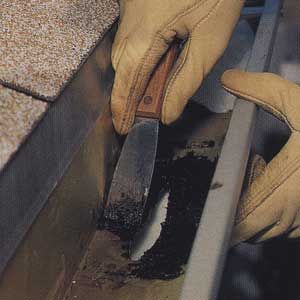
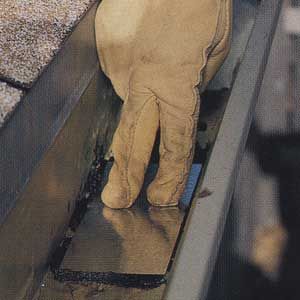
Gutters develop holes in a number of ways. Rust eats through steel gutters, and copper and aluminum versions are easily punctured by falling branches or sharp tools. Occasionally, you’ll find a hole that someone drilled through a gutter in an attempt to drain standing water. (If a gutter isn’t draining properly, it’s either not sloping toward the downspout or it’s sagging and needs to be raised.) You have to patch any hole right away so it doesn’t grow larger. Buy a tube of roofing cement ($1.40) and a metal-repair patch several inches larger than the damaged area. It’s important that the patch match the gutter material. For example, use aluminum flashing to patch an aluminum gutter. If you don’t you’ll encourage electrolytic corrosion—a process that slowly etches away one metal in favor of the other. First, clean all debris from the gutter with a wide putty knife or plastic gutter scoop ($4). Wearing leather work gloves, scrub the area clean with a stiff-bristle wire brush. If there’s any rust around the hole, cut it out with aviation snips.
Fixing leaky joints
Over time, the joints between lengths of gutter can fail. And even seamless gutters aren’t immune to drips. They have seams where the gutters connect to preformed corners and to downspout outlets. Whether it’s a corner or straight joint, the repair is pretty much the same.
Curing sagging gutters
Most gutters are held in place with large spikes that pass through tubular sleeves, called ferrules. When a spike pulls free, a gutter can sag and, in some cases, come crashing down. To repair a sagging gutter, you have to replace the spike with something that won’t withdraw easily, in this case, 7-in.-long FastenMaster Gutter Screws ($10 for a 10-pack).
