
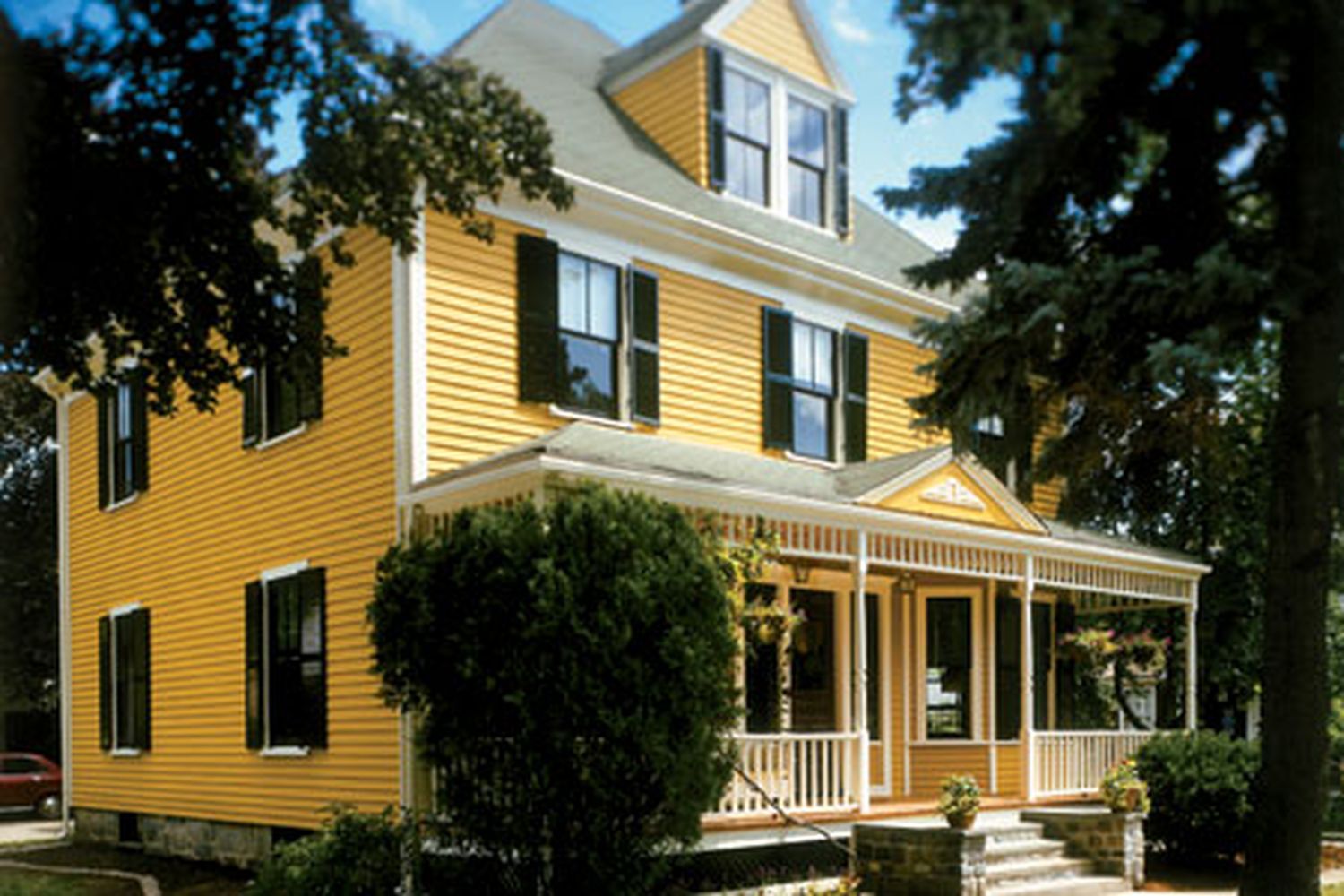
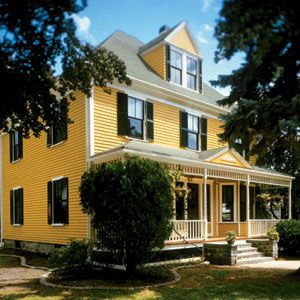
“What’s this?” grumbles Andrew D’Amato, squinting at a minuscule droplet of wet paint on a windowsill. He steps back for the wide-angle view. “Man!” he mutters as he spies a half dozen more all-but-invisible paint beads clinging to the window’s casing. Striding around to the side of the house, he buttonholes the offending employee. “Front of the house, to the right of the door?drips!” he says tersely. The worker trots off toward the site, double-time, as D’Amato shakes his shaggy head. Among the many chores that humans tend to botch or rush, repainting a house’s exterior must rank near the top. The word slapdash, denoting all acts hurried and shoddy, could have sprung precisely from the near-universal tendency to slap pigment on a weary clapboard, then dash off to do something more thrilling. While this tendency is regrettable, it’s also understandable. The perfect metaphor for an endless, grueling task is a lone house-painter staring up at a three-story Victorian replete with mildewed shingles, peeling muntins and alligatored filigree. Exhausting labor, dizzying heights and the specter of lead poisoning?no wonder average mortals blanch. But D’Amato, co-owner of Andrews Painting in Milton, Mass., actually enjoys painting, and he cares deeply about tiny drops on a huge house. “Painting is the last step in the construction process and the most dramatic,” he says. “The change we make is very satisfying.” Over the past 15 years, D’Amato, partner Andrew Lieberman and their crew have attended to dozens of grand old houses throughout greater Boston. “Our clients care about their home,” D’Amato says. “It’s more to them than a place to plunk. It’s a showpiece. That’s why they love us.” A graduate of the Art Institute of Boston, he took up house painting to repay school debts and discovered his affinity for it. Today’s project is in Milton, at D’Amato’s own house, which he and his wife began renovating three years ago. With an expansive front porch and gorgeous fretwork, the circa-1865 house has awesome potential waiting beneath a striated, peeling, moldy, graying skin. “I’m sure it hasn’t been painted since the ’50s,” he says. Which made him eager to get started. But the first requirement of any job is patience. D’Amato never paints an exterior before June. “The long winters in New England saturate wood, especially exposed wood like this,” he says. Atop a 24-foot ladder, he pulls a battery-operated moisture meter from a pocket and presses the meter’s two prongs 1/4 inch into a clapboard high on the house’s north side, typically the last spot to surrender its load of spring rain. “We like the moisture content to be under 12 percent. Here it’s 10, so we’re OK.” Time to paint? Not so fast. The most important single lesson about top-notch house painting is that more than half the job is not painting. “It’s preparation,” D’Amato says. “When we hire people, we tell them that prep is most of it. They say, ‘Yeah, yeah, yeah, I know.’ But as the days go by on the job, they say, ‘I’m sick of this?I’ve got to paint something!'” D’Amato is generally an affable guy, but he never bends on this point. “I tell them, ‘I think you need another job.'”
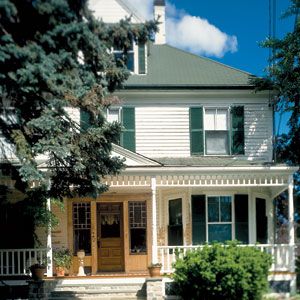
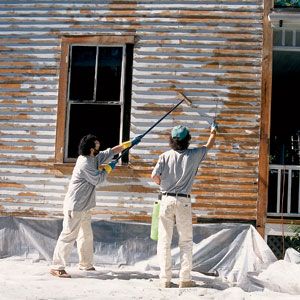
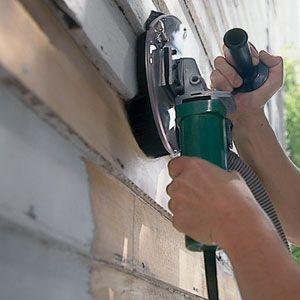
On this sparkling June morning, D’Amato goes to the north side of his house, pulls off one of the abundant paint flakes and examines it. From its approximately 1/16-inch thickness, he guesses the house bears at least 10 coats. Because lead paint was not banned until 1978, all 10 layers may contain the toxic metal. To confine the aged paint he will remove, he unrolls a 20-foot-wide section of 6-mil-thick plastic and staples one edge of it to the bottom of the first course of clapboards. Then he and his crew prop up the tarp’s edges with 1×8 boards, creating an 18-by-20-foot basin to catch debris. Hand-scraping a huge house is only slightly more fun than a messy divorce, so power-tool manufacturers have tried to mechanize the chore. Of the half-dozen tools available?all variations on the theme of a spinning cutter or grinder?D’Amato’s choice for this job is called the Paint Shaver. A head with three triangular carbide scrapers buzzes off a full 1/8 inch from the clapboards, while a vacuum attachment keeps dust to a minimum. (Nonetheless, employee Tom Thevenin wears a respirator.) The shaver is far from perfect—it’s heavy, noisy, awkward, and “chews up the clapboard’s surface pretty bad,” D’Amato says. But the tool does strip paint right down to bare wood. D’Amato concedes that he virtually never goes this far on other jobs—normally, he vigorously hand-scrapes and sands the remaining paint to round over sharp edges and promote adhesion. Strip-mining to bare wood is slow, expensive and unnecessary unless a house is experiencing massive paint failure, as his house is. The mechanical stripper’s bulk prevents it from removing paint within a couple of inches of trim such as corner boards. In these areas, D’Amato employs a heat gun, which softens the paint with hot air, so a handheld scraper can peel off layers like orange skin. His stripper can be adjusted to temperatures ranging from 250 to 1,100 degrees Fahrenheit, the maximum recommended by federal authorities to minimize the risk of vaporizing lead. To protect the wood and prevent fires, he sets the thermostat at the lowest level that does the job. Still, he says, “You want to wear a good-quality respirator with vapor cartridges.” With the wood bare, D’Amato patches missing post corners and other gaping wounds with a two-part wood-epoxy putty. “This stuff is fabulous,” he says. “You just mold it and press it in place. You can fix almost anything with it.” Because the mechanical scraper roughed up the clapboards and the epoxy must be smoothed, the crew commences a double round of sanding using a disk sander with 36-grit paper followed by a random-orbit sander and 60-grit paper. “Strenuous and monotonous,” D’Amato says, “but necessary.” Even the most assiduous scraping and sanding can’t vanquish mold and mildew that have nestled in wood fibers. So D’Amato mixes a cleaning solution: a cup each of bleach and trisodium phosphate to 2 gallons of water. He sprays dirty and/or moldy surfaces and, after scrubbing with a stiff-bristled brush, allows everything to sit for half an hour while the bleach seeps in and destroys. His final prep step is a gentle rinse with the hose to wash off paint dust, bleach and dead mold. “You have to rinse it—you don’t want to mix all of that dust back in,” D’Amato says. “Some people use a power washer, but it’s just too strong. You can write your name in a clapboard with a power washer. They’re great for masonry, but I would never use one on wood.” On D’Amato’s 3,000-square-foot, two-story house, all of this preparation takes the four-man crew two weeks. But finally, after the rinse water dries, comes the moment: The brushes are brought out triumphantly, and the first coat goes on.
A Hidden Layer of Protection
Makers of wooden windows and doors have a secret: Coating bare wood with a paintable water-repellent preservative keeps paint on longer. Now, Andrew D’Amato and a few other top-of-the-line painters are borrowing the trick, which is backed up by research at Purdue University and the U.S. government’s Forest Products Laboratory in Madison, Wisconsin. It’s important that a product’s label make three claims: “water repellent,” “preservative” and “paintable.” The water repellent, often a wax, keeps the wood from shrinking or swelling as much when it rains, so the paint stretches less, stays intact and grips the wood longer. The preservative kills mildew, which could grow into the top paint layer and ruin its look, and fungi that cause wood to rot. There is a wide variation in formulas on the market, however. To find an effective preservative, follow the lead of the many window and door manufacturers who use products that contain 3-iodo-2-propynyl butylcarbamate, an iodine-based preservative often abbreviated IPBC. (Preservatives are usually listed on labels.) Repellents not labeled “paintable” may contain so much wax that paint won’t stick. When in doubt, test first in an inconspicuous area. “After the paint is dry, press a piece of adhesive tape on it,” says Alan Ross, vice president and technical director for Wolman Wood Care Products, which makes water-repellent preservatives. “When you pull it up, does it pull up the paint? Compare it to an area where you haven’t put the repellent.” Bad painters brush paint on bare wood. Good painters prime first. But D’Amato and other excellent painters follow the recommendation of the Forest Products Laboratory in Madison, Wisconsin?they pretreat bare wood with a clear, paintable water repellent to keep the siding from absorbing moisture that gets past the paint. After the repellent dries, the crew masks windows with blue painter’s tape and builder’s paper and applies an oil-based primer. “We spray it on, then brush it out,” says D’Amato, expertly sweeping and stabbing with a natural-bristle brush to work the wet primer into cracks and crevices. He prefers oil-based primers because they penetrate better than latexes do. The primer, however, raises the grain. So, D’Amato’s crew smooths the dried film with light passes of a palm sander fitted with 100-grit paper, then sweeps off the resulting dust with a soft-bristled shop brush. In the course of 133 years, D’Amato’s house has collected cracks, crevices and dings which are unsightly and accelerate leaks and rot. So he guns on 25-year latex-acrylic caulk, patrolling every square foot of the exterior. He seals around trim but leaves cracks between clapboards, so moisture can escape from the house’s interior; if the whole exterior were sealed tightly, migrating moisture could make the paint bubble and peel. For clapboards, D’Amato chooses an airless sprayer, which pumps paint fast (but also wastes much in overspray). For detail work such as lattice, he switches to a high-volume low-pressure sprayer. It ejects less paint but is more accurate.
Caulking finished, D’Amato sprays on another coat of primer. “Now all of the caulk is sealed between two coats of primer. It’s not essential, but at this point it’s easy?you’ve already got the sprayer out and the windows masked off, so why not?” Finally, the painter paints. “My wife, of course, couldn’t pick out a chip, so we had this custom color mixed up,” he says, waving at the burnt-orange shade of flat latex in the open can. After all of the prep work, this long-awaited metamorphosis seems almost instantaneous. “We just spray it on. The surface is already perfectly smooth, so there is no need to brush it in.” D’Amato applies two coats. A sprayed-on coat is thicker, and some is lost to overspray, so a gallon covers about 250 square feet instead of the usual 500. D’Amato sprays as lightly as possible, in keeping with a fundamental rule: Two thin coats are more durable than a single thick one. He paints the body of the house first, then progresses to the trim, brushing on two coats of an appealing glossy off-white around doors and windows. “I always go with an oil-based paint for the trim coat,” he says. “I like its sheen. You can work it longer. You don’t have to worry about it drying up and leaving ugly lap marks.”
In all, D’Amato and his team will spread and spray 53 gallons of paint and finishes on this house: 8 gallons of sealer, 15 gallons of primer, 15 gallons of the burnt-orange body paint, 12 gallons of trim paint and 3 gallons of deep green on the shutters. Total paint cost: $1,530. If he were charging a client, D’Amato estimates the total for materials and labor would come in at about $20,000. “The scraping to bare wood is what really elevates that price,” he says. A less vigorous scrape could drop the cost by half, to as little as $10,000. As the sprayer’s compressor groans and the last coat hisses into place, D’Amato’s affinity for his craft suddenly makes perfect sense. Once forlorn, just another big old Boston-area house gone to seed, the Victorian is now breathtaking. Sweaty, rumpled and dappled orange, D’Amato shades his eyes and takes a long, loving look at the flawless facade. “This is not a color change,” he says. “This is a transformation.”
An Expert Evaluates Old Paint
1. CRACKS. Numerous horizontal and vertical fissures signal that oil-based paint is losing its grip and must be removed. When the buildup is more than 1/16 inch thick, as it is here, sheer weight is part of the problem. “There’s just too much paint on this place,” Andrew D’Amato says.
2. GRAY WOOD. Weathered wood makes a poor base for new paint. Because sunlight degrades the lining that holds wood cells together, surface fibers no longer bond to the wood underneath. New paint will stick?but just to a surface that’s about to be sloughed off. Peeling will reappear.
3. BRIGHT WOOD. Underneath all the gunk is wood that looks as good as new?and may be even better at holding paint than clapboards sold today are. Old clapboards often came from trees that grew slowly and were rift-sawn to minimize warp.
