
When the barbecues flare up each spring and the scent of charring seasoned meat floats across America, it’s a wonder how vegetarians keep their resolve. Even a burger broiled on a rickety hibachi has that primal, irresistible hunter-gatherer allure and a tang of genuine alfresco hospitality. But Dr. Paul Gotkin’s family wanted something more than a primitive fire pit to grill the day’s catch. So under a gazebo, beside the swimming pool, along a yacht-crowded waterway in Jupiter, Florida, masons Chuck and Paul Palazzo gathered the tools and materials they needed to build the Gotkins’ cookout space.
For those who can afford such luxuries, there’s no denying the appeal of these massive monuments to the joy of cooking outdoors. They provide broad expanses of countertop to set down a plate of burgers or basket of buns. Their supporting pedestals, whether built of brick or block, make a perfect all-weather storage space for the mitts, tongs and other barbecuing accoutrements. And unlike those movable feast-cookers that require bottles of propane or bags of coal-dusty briquettes — both of which have a way of running out when most needed — stationary grills can burn natural gas.
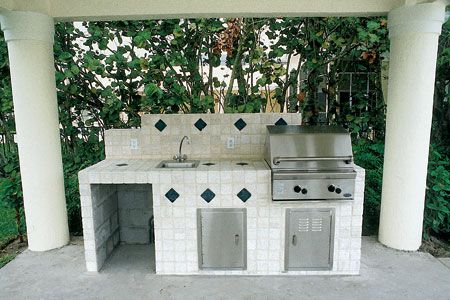
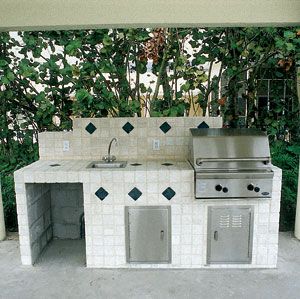
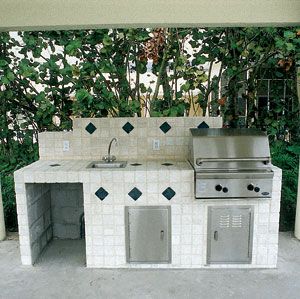
For their barbecue, the Gotkins had a natural-gas grill, 6 feet of countertop and two storage compartments, as well as a refrigerator to keep drinks frosty and a sink. “This is not a barbecue; this is a kitchen,” says Larry Malesky of the Fireplace & BBQ Center in nearby Coral Springs and the designer of the Gotkins’ project.
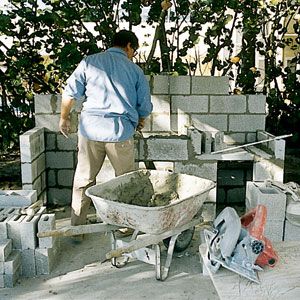
Under the Gotkins’ gazebo, the Palazzo brothers could have been building a miniature house, judging by the stubble of wire and pipe poking out of the gazebo floor: electric wires for the fridge and lights, water-supply and drain lines for the sink, a natural gas line for the drop-in grill. The barbecue cradling all these amenities is going to be solid as a house too. Eight feet long, built of concrete block and pavers covered with travertine tile, this cooking island will be cemented to the gazebo’s 6-inch slab, a sufficient foundation in frost-free Florida. Here the problems are salt air, moisture, bugs and rot. “Ten years ago, people built these out of wood, with tile tops,” Malesky says. “But those don’t last in the Florida climate. Half our business is ripping them out and replacing them with concrete.” He kicked a loose block. “This’ll last forever with no maintenance.”
To avoid blocking the house’s water view, Malesky centered the barbecue between two columns on the gazebo’s north side. In a couple of hours, the Palazzo brothers stacked the 8-inch-thick block into a wall 55 inches high, tall enough to provide a 16-inch backsplash behind the 39-inch counter. They worked in companionable silence, smiles on their faces. Each chore seemed to divide naturally and wordlessly into Chuck chunks and Paul portions. “Mud,” Paul might say, and Chuck would know to drag some bags of mortar over to the wheelbarrow for mixing while his brother laid out the barbecue’s next element.
With chalk and tape, Paul carefully marked out the location of the two end walls, which projected 26 inches from the rear, so that Chuck, with deft slaps, flips, snicks and taps of his trowel, could skillfully build the 4-inch blocks up to counter height. At the left-hand end, he installed a block with screened holes to ventilate the refrigerator. If the barbecue unit had been fired with bottled gas, the containment space for the tanks would have been ventilated too.
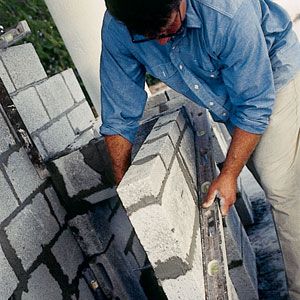
When both the end walls reached countertop height, the Palazzos prepared additional supports for the countertop’s 2-inch-thick concrete pavers. Against the back wall, Chuck mortared pilasters of cut block to counter height and cemented a piece of angle iron on top of them. Then he blocked up the barbecue’s facade, leaving openings for the refrigerator and under-counter storage. Flat bar steel bridged the top of these gaps. On the steel and block, Chuck troweled a ridge of fresh mortar into which he pressed each paver, then he went back and filled all the paver joints. At this point, he didn’t concern himself with making the pavers level?he planned to fix that later.
He set one paver down low, creating a recessed platform for the stainless-steel barbecue unit. “Watch the dust,” Paul said with a grin, as he got ready to cut a 6-inch-square hole in the platform to admit the gas line. Sure enough, the instant his circular saw touched the paver, a gritty white cloud erupted from the diamond blade, enveloping him in a cementitious fog. In the counter itself, he cut a larger hole for the bar-sized stainless-steel sink. Every exposed piece of metal in this installation, even the storage compartment doors, would be stainless steel. Nothing else survives the salt air.
The skeleton of the barbecue was finished. Now it needed skin and innards. Next day, when the mortar had set up, the Palazzos sponged off the pavers and began leveling the countertops. They plopped hills of stiff, low-slump mortar on the counter and flattened them out with a 26-inch aluminum bar, working it back and forth like a sidewalk builder’s screed.
The Palazzos could have encased the pedestal in stucco to match the house, but the Gotkins chose the elegant and more expensive look of tile. So, starting with the countertop, Paul covered every exposed inch of his concrete and cinder-block creation with tumbled beige travertine accented with black pieces. He chose the accent positions with the eye of an artist, sitting back on his heels to study their placement, taking his time, as if he were reluctant to finish.
But after a day and a half of tiling, he did, and the grill was dropped into its new home. A fitter from the local gas company connected and tested the hookup as required by law. The Gotkins had a perfect place to cook and entertain, shaded by the gazebo and coconut palms and cooled by the breezes off the waterway. It wasn’t as elaborate as the job that makes Fireplace & BBQ Center sales rep Larry Malesky proudest — 35 feet of triple-tiered countertop in a U shape plus a refrigerator, an ice maker, a 6-foot gas grill complete with rotisserie and, on the rear wall, a waterfall tumbling into a heated whirlpool — but it would get the family outdoors for dinner. Ena Gotkin thought the family would cook there at least twice a week. “I have a grill on the stove inside,” she said, “but the food doesn’t taste the same.”
Yankee Grill
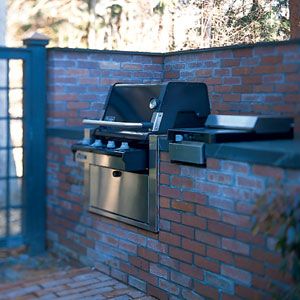
The barbeque at the Milton House started with a simple hole in the ground that would have made a fine fire pit for a family weiner roast. But the backhoe kept digging until the hole was 8 feet long and 4 feet deep, far enough below the frost line to prevent a slab-cracking heave. This Old House contractor Tom Silva had his men fill the cavity with 4 1/2 yards of 3/4-inch washed stone on which they poured a slab. Tom’s men erected a brick pedestal that embraces a gas grill where the new owners could, if they were so inclined, cook some hot dogs. “It’s one of the most elaborate ones I’ve built,” Tom says.
The 4-by-8-foot barbeque appears to be an organic part of the brick patio it sits on. Three feet high with a 20-inch backsplash, it has a stainless steel door in front and dividers inside that create storage cubbies. The centerpiece of this brick cooking island is a 12-inch-wide, 4-burner black porcelain-enamel grill with a roll-back lid, a warming rack and 424 square inches of cooking area covered with stainless steel cooking grates. Next to the grill sits a separate burner for steaming clams or corn on the cob. The countertop itself is three pieces of 2-inch soapstone, a material that takes the heat and can be refinished easily with sandpaper. Tom’s men installed the floodlights on the house to illuminate the area and hooked up the grill to natural gas piped from the house. It’s a handsome pit, but TOH executive producer Russ Morash, a long time barbeque buff, marvels at the effort required to build it. “This is a long way from hot dogs over a fire,” he says.
Fire When Ready
If life seems too short for building a fire and waiting for coals, the quick answer is a gas-powered grill. But which one? The first decision — what size to buy — depends on how many people you expect to cook for, how much they eat and how much you want to spend. Gas grills range in width from 24 to 65 inches and in price from a few hundred dollars to $3,679 (plus tax) for a top-of-the-line cooker with everything, including an infrared rotisserie.
These ready-when-you-are grills burn either natural gas from a pipe or LP (propane) gas from a tank. Their burners are rated in Btus. Larry Malesky of the Fireplace & BBQ Center says 15,000 Btus per burner is the minimum for grilling: “The higher the better to sear in the juices. If you go below 15,000, you’re throwing your money away.” When shopping for Btus, compare apples to apples. Some manufacturers advertise the heat produced by the entire grill surface (they multiply the number of burners by Btus per burner), which gives the impression of a significantly higher output.
Strategies for Piping the Gas
The grill is gorgeous, but there won’t be any sizzling steaks until there’s fuel to cook with. Installing and connecting a gas line is a job only for a licensed plumbing contractor familiar with the local codes, permits, tests, and inspections required by the municipality; a mistake here could blow your house into a pile of rubble. A gas utility is a good place to start looking for a qualified professional.
For natural gas, the piping of choice — and code, in most cases — is schedule 40 black steel pipe, a 1/2- to 1-inch conduit that has been used for about 100 years. (Copper tubing, usually not allowed for natural gas, is often permitted for propane.)
To make the pipe-to-grill hookup, the contractor first turns off the gas, cuts the most convenient line and threads on a T-fitting, to which he attaches the grill line and a shutoff valve. All underground connections are primed, wrapped with a special rust-inhibiting tape 6 to 8 inches on either side of the fitting, and then tested for leaks.
Exterior pipe has to be buried, usually just 12 to 18 inches deep. (Gas will flow even in the freezing northern winters.) Underground black pipe needs a factory-applied plastic coating to stop corrosion and should have a strip of plastic yellow caution tape placed over the ditch after burial, to alert future diggers to stop before it’s too late.
On his next barbecue project, Tom Silva wants to try a flexible gas pipe made of corrugated stainless steel covered by a PVC sleeve. The 3/4- to 1-inch-diameter pipe comes coiled on a reel and uses easy-to-attach threaded brass fittings. It has to be encased in a PVC pipe if buried, and is more costly than black steel, “but it saves on labor,” Tom says. “You just unroll it and screw it on.”
– Sasha Nyary
