
Drying Out a Wet Basement
repairing a wet basement
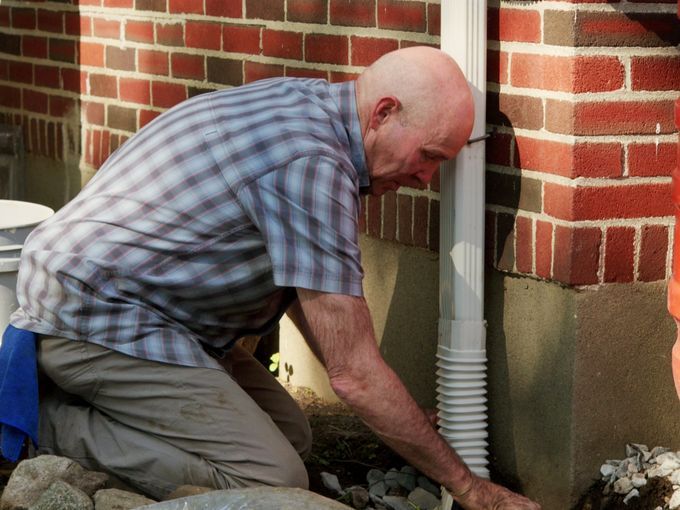
photo by: Carolyn Bates
extend downspouts away from house
illustrations by: Tom Moore
PVC pipe downspout underground
Illustrations by: Tom Moore
interior gutter system
Illustration by: Tom Moore
Interior footing drains made of perforated pipe
Illustrations by: Tom Moore

EXTEND DOWNSPOUTS at least 4 ft. away from the house and install a splash block to help disperse the water.

A dry well fed by a 4-in. PVC pipe running from downspouts can disperse the water gathered from the roof. It should sit on a gravel bed and be wrapped with landscape fabric that holds out silt.

Interior gutter systems catch basement water and channel it to floor drains or a sump pump. Epoxy seals the channel to the floor; the same glue can create curbs to route the flow to a drain.

For sever seepage: Interior footing drains made of perforated pipe set in gravel carry water to a sump pump, which pumps it out of the basement.

How-To Video

Browse More

How to Fix a Leaky Basement Wall

In this how-to video, learn how to fix a basement leak with This Old House general contractor Tom Silva

Advertisement

On Newsstands Now

In the Magazine
June 2008 - Special Reader Issue
best places to own an old house norm abrams tom silva repainted cabinets outdoor kitchen Seattle garden
Advertisement

A wet basement is more than a nuisance. If your basement includes finished living space, any kind of moisture can ruin carpeting, drywall, and framing. Even if you have a crawl space or just use your basement for storage, a simple case of condensation can buckle hardwood flooring on the level above and spawn harmful mold.

If you have a soggy basement, you're not alone. The American Society of Home Inspectors, based in Des Plaines, IL, estimates 60 percent of U.S. homes have wet basements, and 38 percent run the risk of basement mold.

The water most often comes from rainfall and melting snow. Even a small storm can trigger a deluge a house with a 1,500-square-foot roof sheds 1,000 gallons of water for every inch of falling rain. In tougher cases, the problem is rising groundwater, which may even be fed by an underground spring. Once the water accumulates around your foundation, it works its way inside through cracks, joints, and porous material.

A pro cure can cost from a few hundred dollars to many thousand. But even if you're knee-deep in water, don't call your banker yet. You can solve most wet-basement problems yourself for significantly less than you'd pay a professional. The key is to determine which of the three major problems you have: condensation, runoff, or subsurface seepage.

Page:  123456 Next
Article: Gauging Gutters
Sign Up for Our Free Newsletters

Comments

Post a Comment


Anil 6