
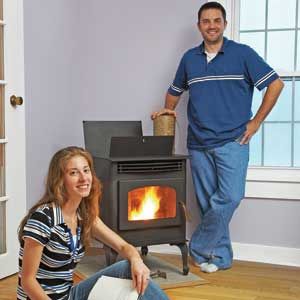
“We put in a pellet stove.”
—Brent Bussey and Jessica Gervais,
Putnam, Connecticut
How It Works: Clean-burning pellets made from compressed recycled sawdust and resembling rabbit feed are poured into the stove’s hopper, where they’re fed automatically into the burn chamber. One internal fan stokes the flame, another send s out convection heat. Electricity powers the fans, feeder, and temperature controls. The stove can save 50 percent or more on home heating costs.
What These Homeowners Did: Although Brent and Jessica insulated their 900-square-foot, two-story house in 2004, they still spent $3,000 on home heating oil, thanks to an old, inefficient furnace. So the next year they brought in a backup: a freestanding, glass-front pellet stove made by Breckwell, a company based in Arlington, Texas. The 185-pound stove sits on a tiled platform in a corner of the living room, with the stovepipe discreetly vented outdoors through the back wall.
Brent and Jessica keep their stove fired up from October to May, adjusting the controls to keep the heat output between 60 and 70 degrees F. Its hopper holds 45 pounds of pellets, or enough to keep the stove going for up to two days without replenishing. (Other models have bigger hoppers, so you can leave town without fear of frozen pipes.) As for maintenance, “Once a week during the winter, we vacuum it out with a wet/dry vac and clean off the glass,” says Brent.
The stove did such a good job they disconnected their furnace two years ago. “The oil company called because they could see that we hadn’t bought oil in a while and were worried about us,” Jessica recalls. “I said, ‘We don’t need any more, thanks. We’re just fine!'”
What They Learned: A freestanding fan, combined with hot air’s natural inclination to rise, easily warms all seven rooms in the house. “If your house doesn’t have an open plan, you do have to get used to keeping doors open so that the heat can travel to each room,” says Jessica.
Keep In Mind: Storing all those pellets someplace dry can be a challenge. Brent and Jessica went through three tons (150 bags) last winter, stashing the 40-pound sacks on a back porch and a pallet in the basement. Still, it’s a good idea to stock up early—the stuff gets harder to find as winter approaches, and three years ago a shortage caused something of a pellet panic.
Payback Period: Less than 2 years
Their Cost: $2,600 for the stove, installed;
$800 a year for premium hardwood pellets
Yearly Savings on Oil Heat: $2,200

“We installed heat pumps.”
—Ed Schwartz and Julie Tung, Ridgewood, New Jersey
How They Work: An air-source heat pump looks something like a central AC compressor, and in summer it works the same way, pumping heat to the outside through lines filled with refrigerant.
During the winter, the same pump extracts heat from the outdoor air—surprisingly, even cold air still contains a large amount of heat—and sends it inside. Air handlers blow the heated or cooled air through a home’s ductwork. Some systems may be equipped with humidifiers for winter comfort and filters to trap allergens.
Historically, heat pumps didn’t work well in areas where temperatures dropped below 35 degrees F, but
Hallowell International recently introduced an “all-climate” heat pump called the Acadia, which works when the mercury dips as low as –30 degrees F. The Bangor, Maine, company says this system can reduce heating and cooling costs by at least 60 percent.
What These Homeowners Did: While completing a renovation of their 5,000-square-foot house, much of it dating to the 18th and 19th centuries, Ed and Julie replaced an ancient furnace with two Hallowell all-climate heat pumps.
What They Learned: Last winter, when temperatures fell to the single digits, the two pumps kept the house a toasty 70 degrees F, even though some rooms were still uninsulated. And at the height of a heat wave last summer, they got the temperature down to 76 degrees. The key is to leave the thermostat at a set temperature for about eight hours at a time so that each pump can perform at peak efficiency.
It also pays to insulate and seal air leaks. By doing this, the owners were able to buy a smaller, less costly system.
Keep in Mind: New ductwork and thick, old plaster walls aren’t a natural fit. To minimize the number of openings in the walls, Ed and Julie located one air handler in the attic and one in the basement.
Payback Period: 7 years
Their Cost: $15,000 for each heat pump,
uninstalled; new ductwork not included
Yearly Savings on Oil Heat: $2,100
To Save Energy, Go Online
Okay, your computer burns some energy, but it turns
out to be darn handy for researching how to slash your power bills. At This Old House, we rely on sites such as these that feature interactive tools to help us figure out where we’re being wasteful—and how to make changes that add up to savings.
For All-Around Know-how
Among many useful features on this
EPA and Department of Energy site is a
tool called ENERGYSTAR@home, an interactive
graphic that guides you on changes
room by room.
For Auditing Yourself
Lawrence Berkeley National Laboratory’s energy calculator prompts you to fill out a questionnaire about your house, then churns out a detailed profile of your energy use and tips on reducing it.
For Remodeling Advice
Energy Efficient Rehab Advisor
Enter info about your renovation plans into the rehab advisor and get back suggestions on making your project more energy-efficient, with estimated costs and payback period.
For Decoding Your Power Bill
A calculator on this website helps you break down your energy bill appliance by appliance so that you can pinpoint and correct problem areas—maybe it’s time to get rid of that second fridge, after all.
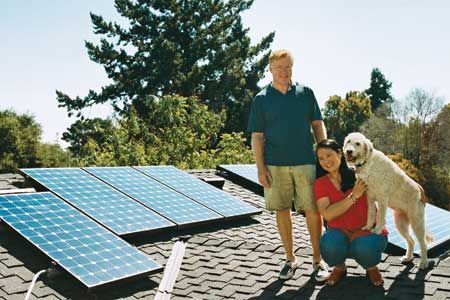
“We got solar panels.”
—Tom Hammer and Sueling Cho, Los Gatos, California
How They Work: Solar panels are made up of photovoltaic cells that contain semiconductors, which absorb the sun’s energy and turn it into electricity. The cells are encased in a protective film, and the panels are typically framed in aluminum and topped with glass. If the system is designed and installed correctly, the panels will produce most, if not all, of the electricity your house needs—at no further cost.
What These Homeowners Did: Three years ago, Tom and Sueling hired a professional installer to put 24 solar panels on the roof of their 2,900-square-foot ranch house. Made by SunPower of San Jose, California, their 4.5-kilowatt system took about a week to get up and running. It generates enough electricity to supply nearly all their needs. When it’s too cloudy or dark to generate enough of its own electricity, the system draws from the grid; when it generates a surplus, the meter spins in reverse.
In the end, the couple pay their utility company about $500 a year, a 75 percent reduction. After installing the panels, they switched to a plan that offers cheaper power during off-peak hours, contributing even more to their overall savings.
What They Learned: “In summer, where we live, the panels need to be washed on a regular basis to get the dust and grime off or they lose power,” says Sueling, who takes turns with her husband climbing up on the roof with a hose every six to eight weeks.
Keep in Mind: Installation is expensive, and the economics depend partly on where you live; some areas are sunnier than others, and some utilities charge more than others. Government subsidies can help reduce initial costs.
Payback Period: 13 years
Their Cost: $26,000, installed, after about $15,000 in state and federal tax credits and rebates
Yearly Savings on Household Electricity: $2,000

“We switched to solar hot water.”
—Bob Alcock and Tim Wheeler, Lost River, West Virginia
How It Works: A flat-plate collector—basically an insulated weatherproof box containing a dark plate covered with glass or plastic—absorbs the sun’s heat and transfers it to water or an antifreeze solution. The solution flows through a long loop of piping that heats water in an insulated tank. On a 90-degree day, the sun can heat this water to nearly 160 degrees F. On cloudy days, when the temperature of the water drops, a backup water heater can boost the temperature; it doesn’t have to work as hard, though, because the water is preheated. The bottom line: You can cut your water-heating bills by more than 50 percent.
What These Homeowners Did: Two years ago Bob and Tim increased the size of their rustic home to 2,660 square feet. As part of a whole-house energy retrofit, they added five solar flat-plate collectors made by Alternate Energy Technologies, which is based in Jacksonville, Florida. Installed on the roof, the collectors heat two 80-gallon water tanks in the basement, so there’s plenty of hot water on sunny days for household needs as well as for the new radiant heat system they added in more than two-thirds of the house. When their water drops below 110 degrees, a 75-gallon propane-heated backup tank kicks on.
What They Learned: The temperature of the hot water varies, depending on the weather and time of day. So they now time their showers—and encourage guests to do the same—to take full advantage of “free” hot water, which is most plentiful late in the day.
Keep in Mind: Panels should face south and catch the sun for most of the day. And solar-heated water is a more fleeting commodity than the electricity produced by
photovoltaic cells, which can be stored in batteries.
Payback Period: 10 years
Their Cost: $14,770, installed, together with radiant floor heating (which they put in largely themselves), after about $2,000 in federal tax credits
Yearly Savings on Propane for Heat and Hot Water: $1,500

“We put up window awnings.”
—David and Nellie Aranowski, South Bend, Indiana
How They Work: These protruding exterior window shades prevent glare and solar heat gain, lightening an air conditioner’s load. Made from weather-resistant fabric, they usually retract manually, via a cord system, or mechanically, with a remote, to protect them from wind damage and, in frost-prone areas, to allow sunlight to warm a home’s interior in winter. They can reduce cooling costs by up to 24 percent, depending on the climate.
What These Homeowners Did: David and Nellie moved into their 1920s Dutch Colonial Revival three years ago, just in time to experience summer as a nonstop sauna. That’s also when they noticed tree stumps near the house—and realized it would need some shade. They called on Custom Awning, a local shop in Osceola, Indiana, to install four large awnings made of durable acrylic fabric across nine windows on the house’s sun-drenched south- and west-facing sides.
What They Learned: The awnings allowed the couple to raise the thermostat on their central AC by 5 degrees F while making a dramatic difference in their comfort level. The black-and-white striped awnings also added major curb appeal. “The house is so darn cute now,” says Nellie.
Keep in Mind: Even top-of-the-line awnings only last about 10 years.
Payback Period: Here’s one case where you may not recoup all your cost in energy savings, but you’ll vastly improve your quality of life.
Their Cost: $1,920 for four large awnings, installed
Yearly Savings on Electricity for AC: $90

“We put in tube skylights.”
—Justin and Kristin Gonzalez, Vista, California
How They Work: About 10 to 20 inches in diameter, tubular skylights channel natural light where windows or skylights can’t. A tube lined with reflective material is inserted through a hole cut in the roof and lined up with a second hole cut in a room’s ceiling. A clear plastic dome tops the rooftop end, and a ceiling fixture caps it below. Sunlight bounces off the mirrorlike lining and spills from the fixture, so you don’t waste money turning on lights.
What These Homeowners Did: Last fall, while renovating the 1,400-square-foot ranch Justin and Kristin share with their 2-year-old daughter, they learned about tubular skylights just as recessed light fixtures were being installed. Since the house faces a busy street, they keep the blinds drawn in several rooms, so they need a lot of light. The couple invested in 10 tubular skylights made by Solatube, a local company, for their kitchen, family room, a hallway, two bathrooms, and the master closet.
What They Learned: “All that natural light just makes you feel better,” says Justin. “It makes the whole house feel more relaxing.” It also changed the way they live. From about 6 a.m. to 7 p.m., they don’t turn on a single light—or pay to power one.
Keep in Mind: An array of plastic bubbles may not improve the look of your roofline. To preserve your facade, you can place the tubes in back and angle them across the attic—with a small sacrifice of light—to their desired location.
Payback Period: 10 years
Their Cost: $5,000 for 10 tubes, installed
Yearly Savings on Electricity for Lighting: $500

“We added denim batts.”
—Bryant and Stephanie Pearson, Portland, Oregon
How They Work: Like all insulation, recycled denim batts help to block drafts and curb heat loss. They offer about the same R-value protection as fiberglass but take less energy to produce, since they’re made with scrap fibers from textile mills and garment factories. The material is treated with nontoxic borates to make it insect- and fire-resistant. As with any insulation, denim batts can cut energy costs by up to 30 percent.
What These Homeowners Did: When it came time to insulate the family’s 900-square-foot basement, Bryant reached for a soft, familiar material: denim. “I come from a construction family,” says Bryant, “and the worst job on any work site is having to put up fiberglass insulation. It gets everywhere.” He chose instead UltraTouch denim batts, made by of Chandler, Arizona, and installed them in a day. (Finishing the drywall was another story.)
What They Learned: “Denim insulation throws off a lot of dust,” says Bryant, who wore goggles and a mask, and vacuumed frequently.
Keep in Mind: Recycled denim batts cost 15 to 20 percent more than comparable fiberglass—worth it, says Bryant, to work with no-itch, formaldehyde-free cotton.
Payback Period: 2 to 3 years
Their Cost: $800, with DIY installation
Yearly Savings on Gas Heat: $300
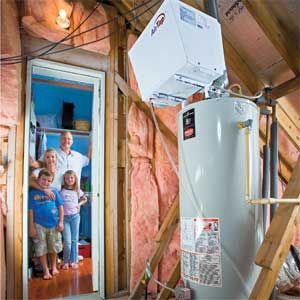
“We got hot-water heat pumps.”
—Jim and Rachel King, Rosharon, Texas
How They Work: Like other heat pumps, this scaled-down version extracts heat from the surrounding air and transfers it to another medium—in this case, to water stored in a conventional standby tank. The AirTap, as it’s called, measures less than two cubic feet, weighs 48 pounds, and sits on top of your existing hot-water tank. AirGenerate, the Houston company that makes the device, says it uses only one-quarter of the electricity drawn by a conventional electric hot-water tank.
What These Homeowners Did: Jim and Rachel, who live with their two kids in a 3,750-square-foot house, had been heating water with propane—at a monthly cost of $130. “You’d hear the flame go whoosh all day long,” says Jim. “It was like hearing money go down the drain.” When they learned about the AirTap earlier this year, they decided to buy one for each of their two 50-gallon hot-water tanks. A contractor installed them in about three hours.
What They Learned: “You still hear a bit of noise sometimes, like a bathroom fan running,” says Jim, who is relieved to know his kids are no longer sleeping near a propane flame—one water tank is upstairs. And how’s the water? “We haven’t had a cold shower since we turned off the propane.”
Keep in Mind: The manufacturer says an AirTap should last 10 years but won’t perform as well or last as long if the existing tank is in poor condition.
Payback period: 7 months
Their Cost: $450 each, or $900 total, uninstalled
Yearly Savings on Propane for Hot Water: $1,560

“We went with a geothermal heat pump.”
—David and Jen Schlegel, Camp Hill, Pennsylvania
How It Works: A geothermal system, or ground-source heat pump, taps into the earth’s constant temperature of 55 degrees F to heat and cool a home efficiently. In a vertical installation, piping is buried up to 300 feet deep. In a horizontal system, the piping snakes under a wide swath of land, 3 to 6 feet below the surface. The pipes contain an antifreeze solution that flows beneath the ground and then through the heat pump indoors, which transfers the heat from the liquid to air handlers. In summer the unit cools the house by pumping heat back into the ground. The systems can cut heating and cooling bills by up to 40 percent.
What These Homeowners Did: David and Jen were burning through $1,150 worth of home heating oil and spending about $375 on electricity for central AC each year in their 1949 Colonial Revival. Just as important, their furnace, water heater, and AC compressor were close to shot. So last fall they brought in a local geothermal specialist to take a look at their 1,262-square-foot home. The company sank two pipes 190 feet deep into their yard. It took the crew about a week to do the work, which included drilling, removing the old furnace, wiring an electrical service panel, and installing a new heat pump made by ClimateMaster, which is based in Oklahoma City. The heat pump fits into the basement and, fortunately, could be used with the existing ductwork.
What They Learned: “You get nice, even heat throughout the house,” says David. And a geothermal system provides an endless supply of heating, cooling, and hot water.
Keep in Mind: Drilling is costly, and nerve-racking, because you don’t know what you may hit. David and Jen paid $11 per foot. But if the drill had hit water, sand, or stone, the price would have risen to $13 to $17 per foot. The larger the house, the more pipe you need underground.
Payback Period: 8 years
Their Cost: $11,600, installed, after a $300 federal tax credit
Yearly Savings on Oil and Electricity for Heat, Hot Water, and AC: $1,525

“We hooked up a whole-house fan.”
—Dwight and Shannon Okahara, Santa Clarita, California
How It Works: A large fan at the center of the house pulls in cool air through open windows on lower floors, drawing warm air up and out through windows or roof vents. Whole-house fans use about one-fifth of the electricity consumed by central AC.
What These Homeowners Did: First, Dwight and Shannon did their homework. They learned that their climate—cool early in the morning and at night—is ideal for this old-fashioned fix. So last spring, Dwight installed a Master Flow fan made by of Wayne, New Jersey, in the attic floor of their 2,500-square-foot house. He cut a hole in the second-story hall ceiling and, working from the attic, mounted the fan on top of the exposed joists. Then he hard-wired the fan to a switch in a nearby bedroom and finished the hall ceiling with a louvered panel that closes automatically when the fan is off. “It was a ‘measure nine times, cut once’ type of job,” he deadpans.
What They Learned: They can lower the indoor air temperature by 5 degrees F in an hour by running the fan full tilt. “The funny part is, it can get too cold at night,” says Dwight. “I end up turning it off and getting under the comforter.” It takes a little experimenting, opening some doors and windows and closing others, to direct the cool air where you want it most. Last summer they used their central AC only when the outside temperature hit 85 degrees F.
Keep in Mind: A whole-house fan doesn’t dehumidify the way AC does. It works best when located in the center of the house. Some models are loud—decibel levels range from 60 to 71. The Okaharas’ generates 65 decibels, about as loud as a window air conditioner. Also, since it has no filter, a whole-house fan will draw in outdoor allergens.
Payback Period: 6 to 8 months
Their Cost: $260, with DIY installation
Yearly Savings on Electricity for AC: $1,500