
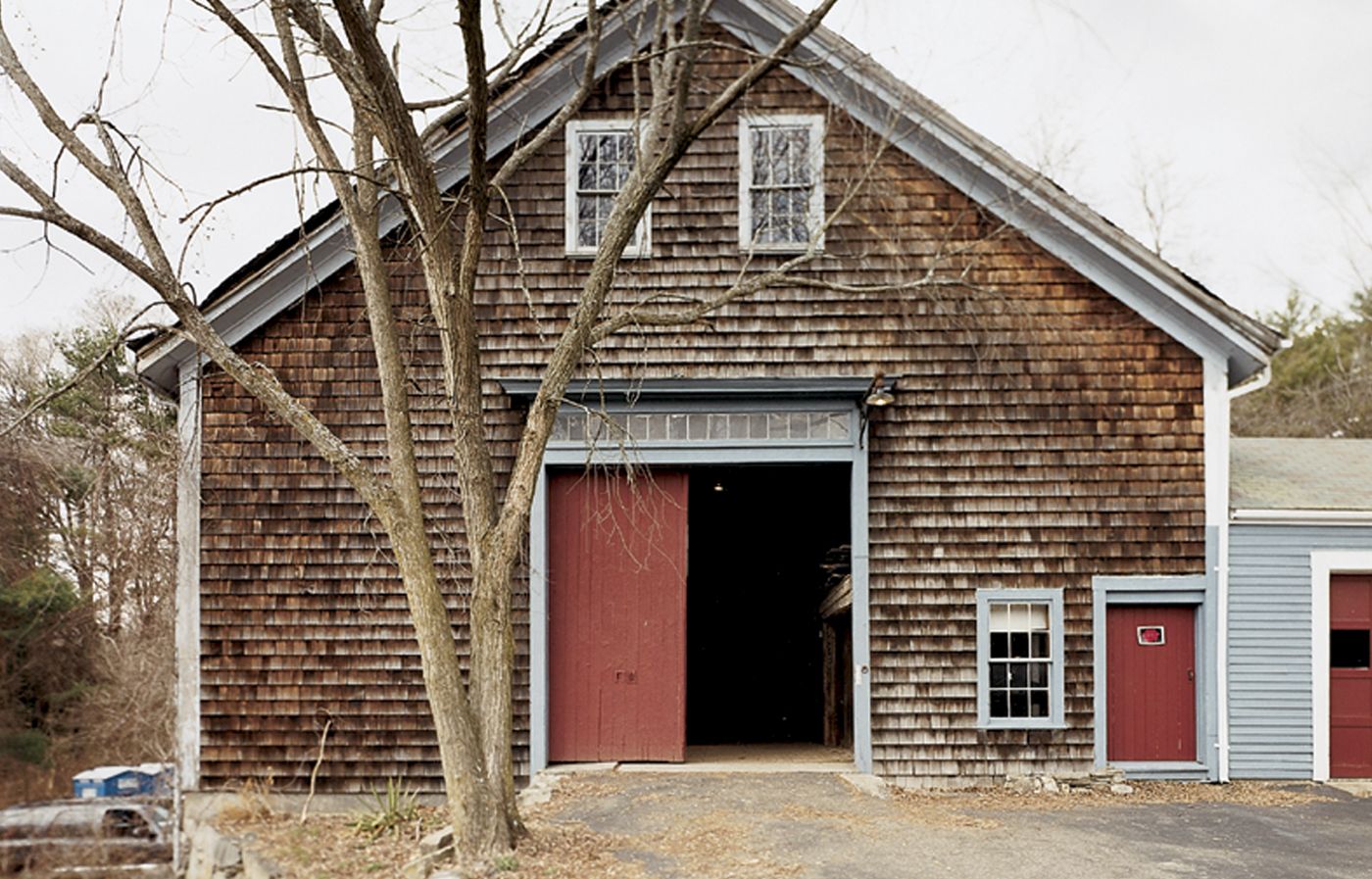
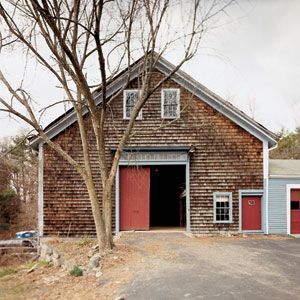
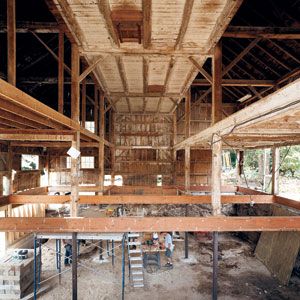
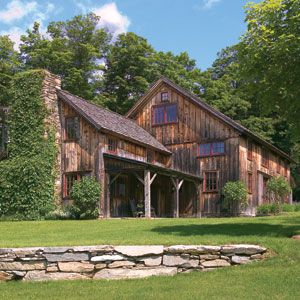
Tom Silva adjusts his glasses, picks up a reciprocating saw, and makes a perfect Z-shaped cut through the bottom of a 150-year-old hand-hewn post. The massive timber is a major structural element in the barn portion of the classic New England connected farmhouse that is the subject of the current This Old House TV project in Carlisle, Massachusetts. But right now it’s dangling in midair, temporarily relieved of its duties while Tom performs surgery.
“About half the posts in here were five inches too short,” says TOH’s general contractor as he sets the saw aside. “They looked fine until we replaced the structure that would support the floor and started to lower the jacks holding up the barn. That’s when we noticed the problem.” The old barn floor had been built on two levels — no one is sure exactly why. But years of accumulated debris and patchwork repairs had hidden the step-down. To lengthen the posts, which will be visible once the barn is finished, Tom splices in additional sections of equally worn and aged timber salvaged from posts he’s replaced in the garage below. He uses a half-lap scarf joint, a beveled zigzag that’s fastened with construction adhesive and locked tight by the weight of the barn itself — no hardware needed.
The job isn’t that complicated. But it’s a reminder that creating modern homes from fallow barns involves a lot more than just hauling out the rusty junk, brushing aside some cobwebs and cow manure, and hanging drywall. Still, despite their often derelict condition, there’s a romance to these rustic structures that makes people yearn to reinvent them as habitable homes.
The Appeal of Soaring Spaces
It’s not hard to see why old barns inspire the imagination. The high-peaked timber frame with its massive exposed posts and rafters is reminiscent of awe-inspiring Gothic churches or medieval castles. At the same time, the rough elegance of hand-shaped beams and the rich patina of centuries-old boards have a quintessentially American feeling, connecting us to our pioneer roots.
That rugged appeal is hard to find in any house, however old. Ken Epworth has dismantled hundreds of these derelict structures and brought them back to his workshop to be meticulously cleaned and readied for reassembly as homes. “You’re not going to live long enough to get that color out of new beams,” says Epworth, whose company, The Barn People, is based in Vermont.
Because barns have usually been nothing but barns throughout their life, they have aged both with use and with the slow-moving effects of time and weather. Tight-grained posts have darkened and dried out, critters have left behind scratches and holes. Most of Epworth’s projects involve early-19th-century barns that were originally shaped and assembled by hand. “People are going for that organic look,” he says.
Of course, one of the biggest draws of old barns is the lofty space they offer, dwarfing even the largest rooms in conventional homes. But incorporating all the elements of a house into what is essentially one big blank slate of a room, minus the stall walls and hayloft, presents particular challenges. Les Fossel, a Maine contractor who has restored at least 100 barns in New England over 30 years, says, “Barns make great barns, but they don’t always make great homes. Often someone falls in love with that wonderful open space — but then they realize they need bathrooms, and they want privacy in their bedrooms, and they start cutting it up and adding walls. Pretty soon, you go from a great barn to a bad house.”
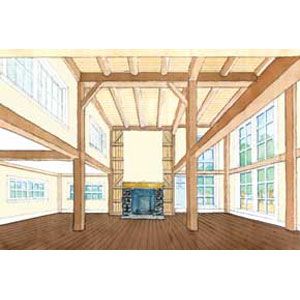
Because there are only so many ways one can cut up a simple gable-end barn, Epworth says that many result in similar layouts: a great room with a fireplace at one end and bedroom loft areas up above. Kitchens and other common areas either open onto that great room or get tucked away under the loft spaces. Some barns become additions to existing houses, serving as a family area or recreation room, and others remain as separate buildings, often as guest houses or pool houses. In those cases, parceling out the space is less of a design dilemma.
At TOH’s Carlisle project, the barn is only a wing of the house, so architect Jeremiah Eck is leaving as much open space as he can, designating a two-story “living hall,” or gathering room, for about a third of the space, and creating private guest quarters on the second level. He also uses glass to maximize the open feeling of the floor plan: One corner of the living hall is glazed floor-to-ceiling, while some loft rooms have interior windows overlooking the great room below.
Shoring It Up, Sealing It Tightly
Of course, the layout isn’t the only hurdle to overcome in converting a barn. Many are in poor shape because busy farmers of limited means struggled to maintain these massive structures. The biggest problems tend to be in foundations, typically made of loose-laid dry stone. Since barns rarely have in-ground drainage, wet soil gradually works its way between the stones, loosening them and causing the building to shift. The timbers themselves — particularly the rafters — are also vulnerable to water damage. Cracks in the roof boards let in rain, which runs into the walls and causes them to warp and bulge over time. Then there are the bugs, like the termites and powder post beetles that were discovered in the Carlisle barn. There, at least, the treatment was simple: Exterminators sprayed on a nontoxic borate, which poisons the insects’ food supply.
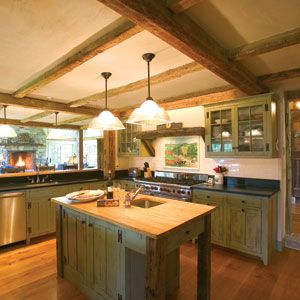
Another issue is how to create an energy-efficient and weather-tight home while preserving the barn structure’s character. A popular solution is to sheathe the exterior with structural insulated panels, sealing and insulating the barn from the outside. The original barn-board sheathing, posts, and beams can then be left exposed for the interior walls and ceiling, adding to the rustic feeling of the house; or, for a more finished look, the barn boards can be covered over with finished drywall between the exposed posts.
The energy-efficient plan for Carlisle, however, preserves both the barn’s interior and exterior. Tom Silva will install 2x3s turned flat, on 16-inch centers, between the posts and beams, spray between and behind them with polyurethane foam, then apply drywall on top. The resulting walls will leave 1 1/2 inches of the timbers showing.
While such challenges don’t necessarily rule out a barn or other outbuilding for conversion, they can add considerably to the cost. For a large barn like the one in Carlisle, treating an insect infestation runs about $500. But jacking up the structure, replacing its foundation, and adding an in-ground curtain drain around its perimeter can cost over $25,000 (and considerably more if the new foundation is stone). The good news is that if a barn qualifies as a historic structure, homeowners may be eligible for tax relief. The federal Rehabilitation Tax Credit offers a tax reduction based on a percentage of the money spent to fix up a historic structure. In addition, many states offer income-tax credits or property-tax abatements to homeowners who rehabilitate old buildings.
Saving a Part of the Past
The carpenters who built these barns would appreciate the care with which renovators like Tom convert these old buildings. (And they would certainly recognize his half-lap scarf joint.) They assumed that the barns — like the surrounding farms — would be around for centuries.
As modernization forces small farms to shut down, leaving their outbuildings to the elements, converting a barn is one way to save a disappearing vernacular form. And by turning these “agricultural cathedrals,” as Fossel calls them, into houses, Americans are also preserving their cultural heritage. “They recall a time when small communities gathered together for barn raisings and a self-sufficient farmer’s world reached no farther than the town border,” he says.
Ken Epworth, of The Barn People, says he is still enthralled each time he throws open the door to one of these relics for the first time and gazes up at the void. “You’ve got to give your eyes a few minutes to adjust,” he says. “But then you start seeing things. You see that beautiful honey color of the wood. You have a structure with integrity. You’ve got history, mystery, and charm. That’s hard to duplicate today.”
Where to Find It
Architect:
Jeremiah Eck Architects Inc.
Boston, MA
617-367-9696
Barn restoration:
The Barn People
Windsor, VT
802-674-5898
Restoration contractors:
Les Fossel
Alna, ME
207-586-5680
Borate-based termiticide:
Bora-Care, Nisus Corporation
Rockford, TN
800-264-0870
For more information on tax credits for historic renovations, go to www.nationaltrust.org or contact your state’s office of historic preservation and your local tax assessor.